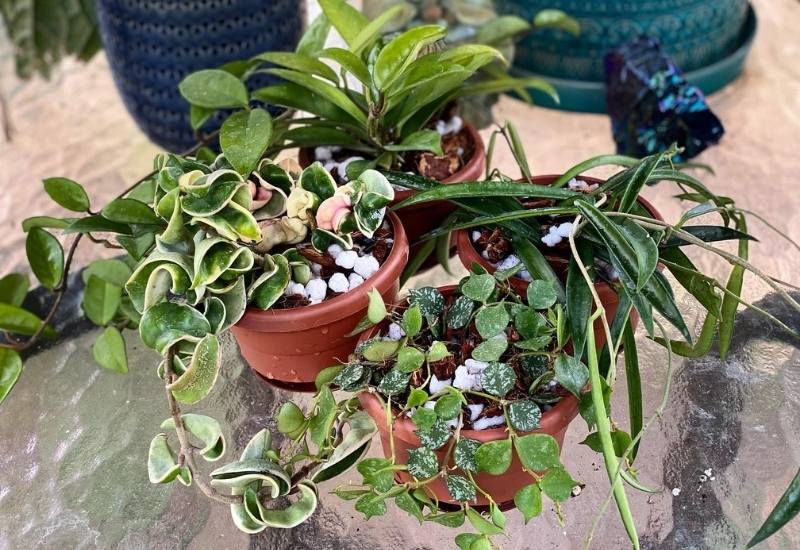
Welcome to the stunning world of Hoya plants. These exotic, fragrant, and evergreen tropicals are semi-succulent wonders, growing as creepers, vines, and even a few shrubs that make for absolutely incredible houseplants. You might also hear them called waxplant, waxvine, or waxflower, which perfectly describes their glossy leaves and star-shaped clusters of waxy blooms.
Under the right conditions, some Hoyas can bloom almost continuously throughout the year, filling your home with a lush, tropical scent. Despite their high-end looks, these plants are surprisingly low-maintenance. You’ll be amazed by the beauty of their fleshy leaves, waxy flowers, and extraordinary colors and shapes.
Hoyas originate from South and Southeast Asia, Polynesia, and Australia. This amazing genus, part of the huge Asclepiadaceae family, includes 200 to 300 different species. About 40 to 50 varieties, including cultivars and hybrids, have found their way into garden centers and homes. From common types like the gracilis wax flower to rare gems like the Hoya callistophylla, explore 40 of the most beautiful Hoya varieties that will be an excellent addition to your plant collection. Along with pictures and descriptions, you’ll find tips to help you identify and care for your specific Hoya.
Hoya Plant Colors And Shapes
The botanist Robert Brown named this genus hoya to honor Thomas Hoy, who was the head gardener for the Duke of Northumberland. Hoy was a specialist in cultivating tropical plants in greenhouses for many years. Hoyas are a genus of tropical plants, primarily epiphytic vines, known for their interesting flowers and foliage.
They come from the humid forest regions of South Asia and Oceania. There, they often grow on trees, though some can be found in rocky environments. Only a handful of species grow as shrubs.
Hoya is famous for its flowers. They can be found in many colors, including white, yellow, orange, red, and purple. The blooms are always star-shaped, though sometimes they are joined together to form a cup. The five petals contrast with another star in the center called the corona. This central part contains the reproductive organs, creating the look of one flower inside another.
The two contrasting colors produce a beautiful decorative effect. The round flower clusters, called umbels, often pack the blossoms together for a showy display.
The blooms have a waxy appearance, almost like a succulent in texture. Most Hoya varieties have small flowers. However, some, like Hoya imperialis and Hoya coriacea, can have individual blossoms reaching 3 inches across, with umbels that are 12 inches in diameter.
The flower clusters grow on spurs, which appear before the plant actually blossoms. These look like soft, new stems with a tiny cluster of flowers at the tip. Many flowers release a strong fragrance and secrete a sweet, clear nectar that attracts pollinators, especially at night when their scent is strongest.
Hoya leaves are elliptical and usually glossy. They are mainly a mid-green color, but some variations exist. The size varies greatly depending on the variety, from just a fifth of an inch long to a massive 14 inches.
This plant is primarily grown as a houseplant because it is not cold-hardy. It thrives in protected environments and a light growing medium rather than in regular soil, though growing it in soil is still possible.
Hoya Factsheet
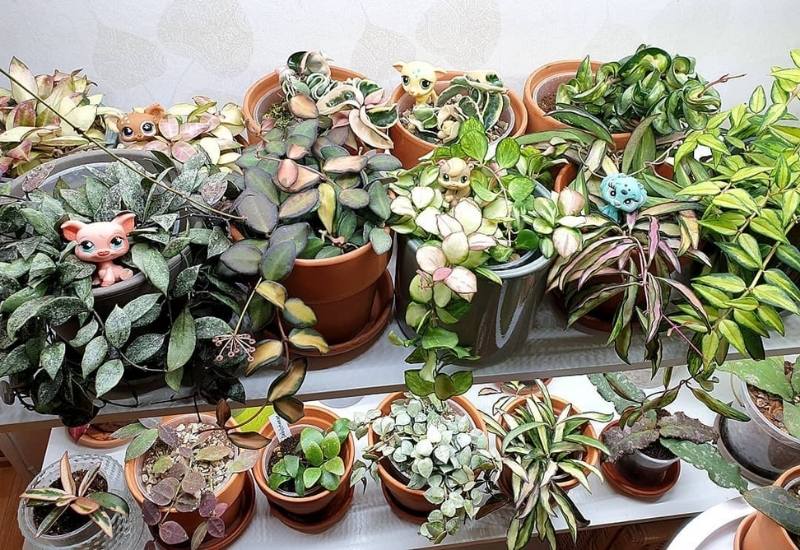
For a quick reference guide on the Hoya genus and all its varieties, here is an easy-to-use fact sheet.
Botanical name: Hoya spp.
Common name(s): hoya, waxplant, waxvine or waxflower.
Plant type: evergreen flowering perennial vine, creeper or rarely shrub; some are epiphytes.
Size: 1 to 15 feet in length (30 cm to 4.5 meters), depending on the species.
Potting soil: use a growing medium like two parts orchid bark and one part coco coir and one part perlite. Add a dash of horticultural charcoal for health.
Outdoor soil: to grow it in full soil, amend it with excellent drainage (perlite, coarse sand) and a medium like coconut coir. Better is in containers anyway.
Soil pH: the growing medium should have a pH of about 6.0, so mildly acidic, however it will tolerate neutral as well (up to 7.5).
Light requirements indoors: bright indirect light, especially diffuse.
Light requirements outdoors: morning Sun or dappled shade.
Watering requirements: medium moist.
Fertilizing: regular, on average feed once a month with organic. fertilizer with NPK 2:1:2 or 3:1:2, switch to 5:10:3 when about to bloom.
Bloom time: usually spring and summer.
Hardiness: USDA zones 9 to 11, depending on the variety.
Place of origin: Asian countries like Philippines, India, Thailand, Malaysia, Vietnam, Bangladesh, Indonesia Polynesia, New Guinea and also Australia.
How to Care for Hoya Plants
If you’re convinced and ready to bring a waxplant home, you will need a few detailed tips on how to care for it. Here is a care guide you can keep handy.
Hoya Lighting Requirements
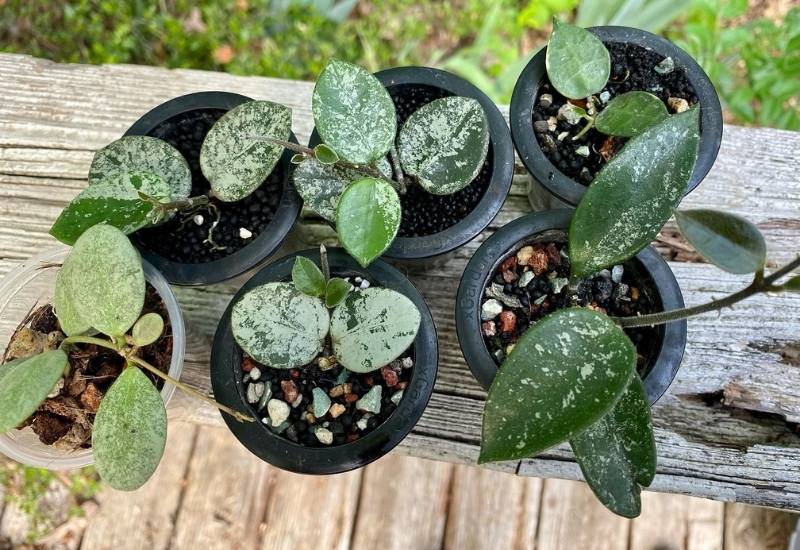
Hoya needs plenty of bright, indirect light but absolutely cannot tolerate direct, strong sunlight. Remember that in its natural habitat, it grows within the canopies of trees.
It prefers a south or east-facing window, as it favors afternoon shade. Position your plant at least 5 to 8 feet away from the window, depending on the intensity of the sunlight where you live.
How to Prepare Good Hoya Potting Mix
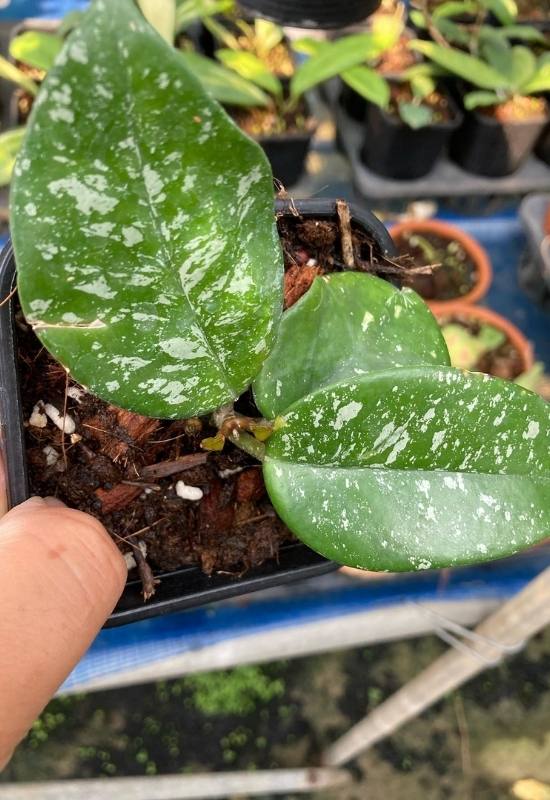
When grown in a container, Hoya does not require any soil. In this way, it is more like an orchid, as most varieties grown indoors are epiphytes.
Instead, it needs a growing medium that is mildly acidic and well-drained. A good mix could be:
Two parts orchid bark
One part coconut coir
One part perlite
A dash of activated charcoal; this is to keep fungi at bay.
Hoya Watering Routine and Requirements
Hoyas need humidity, as they come from very rainy regions. Like all epiphytes, they also need moisture to absorb nutrients from the air. However, their needs change between summer and winter.
During spring and summer, water your Hoya plant whenever the top inch of the soil dries out. Use room-temperature water and soak the growing medium completely. Be sure not to leave water in the saucer, as this can cause root rot. In the summer, you can bathe the foliage with soft, lukewarm water, but avoid getting the flowers or buds wet.
Reduce watering starting in the fall and continuing through winter. Your goal in winter is simply to prevent the soil from drying out completely. You will want it to be mostly dry, as your plant will drink much less during this season.
Hoya and Its Humidity Needs
As a tropical plant, Hoya also enjoys humid air. Misting your Hoya can help, especially in the summer or during the dry season in your area.
You could also place a second saucer or tray under your waxplant, making sure it does not touch the growing medium or roots. Fill it with water to increase the humidity level around the vine.
How to Feed and Fertilize Hoya Plants
Hoya requires regular feeding, typically once a month. Use a good organic fertilizer mixed into the water.
The NPK ratio should be around 2:1:2 or 3:1:2 while the plant is in its vegetative phase. About 8 weeks before it is set to bloom, switch to a 5:10:3 fertilizer.
How and When to Repot Hoya Plants
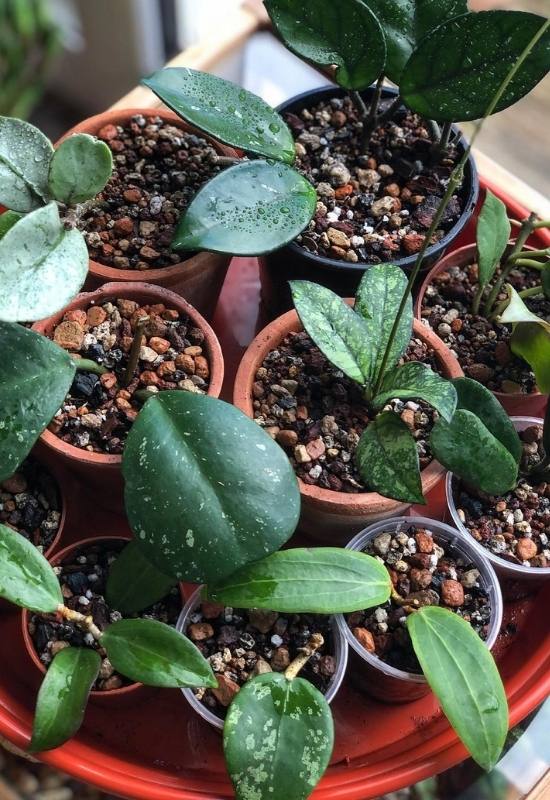
You can repot your hoya when it has truly outgrown its container or if you need to change the growing medium. In the latter case, be very careful if the medium starts to smell or degrade in any way.
When you first purchase your wax plant, repot it and check to ensure it has no root ball. If it does, break it apart. A root ball is a clump of soil that forms at the very base of the vine.
This happens because nurseries often start them in light soil rather than a proper growing medium. If you leave the root ball intact, your plant may die from root rot.
To repot, remove the vine from its pot and discard all the old potting mix. Disinfect the new or old pot. Place the roots in the middle and gently cover them with a fresh mix, then water.
How You Can Prune Hoya Vines
Pruning Hoya plants can encourage more flowering. In fact, new buds will form on newly grown vines. As with all climbers and creepers, pruning Hoya is necessary and also very easy.
Avoid pruning your Hoya when the plant is in bloom.
Cut under a node, above where you want new branching.
Be careful not to damage spurs.
Never cut more than 1/3rd of the foliage.
How to Propagate Hoya Plants
Taking stem cuttings in the spring and summer is the easiest way to propagate your hoya plants. And it is simple!
Avoid taking cuttings when the plant is in bloom.
Take a long cutting with a sterile blade, a few nodes and about 4 to 6 inches long (10 to 15 cm) depending on the size of your variety.
Eliminate all leaves apart from the top one.
Dip the cut part in apple coder vinegar for one minute.
Place it in a glass or jug of water.
Wait till it develops new roots.
Allow the roots to reach about 4 inches long (10 cm)
Transplant in a pot with growing medium.
This method allows you to have many hoya plants from a single one you buy. However, you cannot change the variety, so which one is best for you? Let’s find out.
40 Hoya Plant Varieties to Take Your Plant Collection to the Next Level
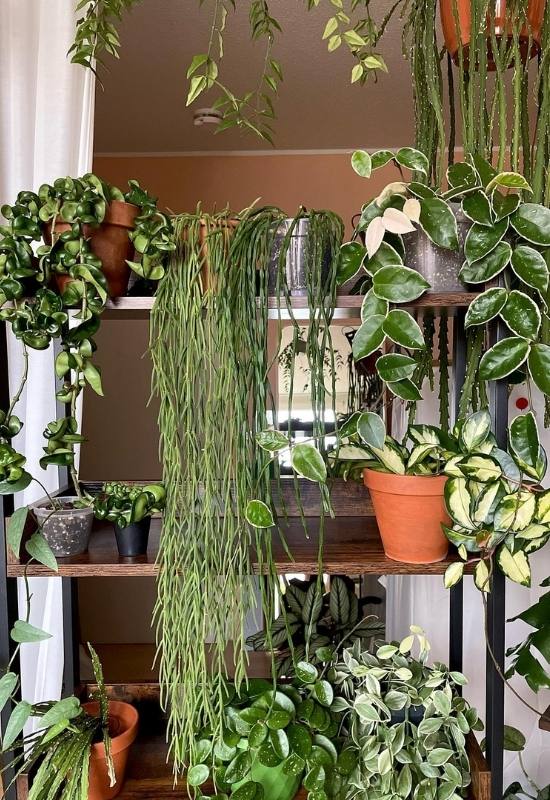
With natural species from tropical regions and many cultivars and hybrids bred over the last century, here are 40 stunning Hoya varieties to bring into your home or garden.
1: Giant Wax Plant (Hoya lauterbachii)
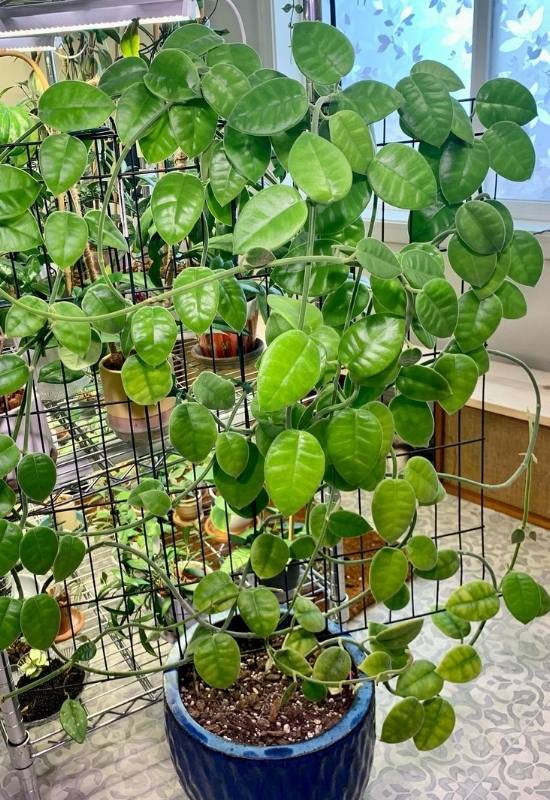
The giant wax plant lives up to its name. It is one of the most spectacular hoya varieties you can own, and its special feature is its massive, very fragrant blooms.
Each individual flower is about 3 inches across, the size of a teacup. And it even looks like one. The petals are joined into a bowl shape with a bright canary yellow center and ruby to purple edges.
The corona, on the other hand, is golden yellow, creating a very stark color display. The clusters, or umbels, are enormous, with up to 12 blooms each and a diameter of 1 foot.
The leaves are glossy, waxy, and mid-green, and this vine can grow taller than a person. It is, in fact, one of the few varieties suitable for outdoor growing.
Natural or cultivar: natural species.
Flower color: canary yellow, ruby red to almost purple and golden yellow.
Flower size: large (3 inches across, 8.0 cm).
Plant size: 6 to 8 feet long (1.8 to 2.4 meters).
Suitable for outdoor growing: yes, in USDA zones 10 or above.
2: Porcelain Wax Flower (Hoya carnosa)

Porcelain wax flower, Hoya carnosa, is a classic small variety of waxplant that you can find in many garden centers.
The sweet-smelling, star-shaped blooms are white with a pink fade, while the internal corona is dark red.
They are quite small and form beautiful round clusters amid the vines. The leaves are elliptical and mid-emerald green on top, with a light, almost lime green underside.
The foliage is also quite glossy and attractive. This is a small variety, perfect for coffee tables or hanging baskets.
Natural or cultivar: natural species.
Flower color: white with a pink shade and dark red.
Flower size: small.
Plant size: 2 to 4 feet in length (60 to 120 cm).
Suitable for outdoor growing: no, only in tropical regions.
3: Hoya Pubicalyx (Hoya pubicalux)

Hoya pubicalyx is a sought-after houseplant for its very unique qualities. The leaves are extremely glossy and lush, mid to dark green in color, giving it a very exotic look.
The ‘Pink Silver’ cultivar features variegated foliage as well, with white to silver-gray specks that make it highly decorative.
Even the flowers are quite original and distinctive. They are still waxy and very fragrant, especially at night, but they are also known for being lightly fuzzy.
The color is usually in the pink to dark magenta range, sometimes with white and cream parts.
However, if you want a truly striking variety, ‘Black Dragon’ has very dark purple-violet petals and a red-magenta corona in the middle.
Natural or cultivar: natural but with cultivars like ‘Black Dragon’ and ‘Pink Silver’
Flower color: magenta to white via pink, or magenta and dark purple, almost black.
Flower size: small.
Plant size: up to 8 feet long (2.4 meters).
Suitable for outdoor growing: no.
4: Hoya Burtoniae (Hoya burtoniae)

You will recognize Hoya burtoniae by the unique color of its foliage. The short, elliptical leaves appear very pale green in the center with a thin, dark brownish-green rim around the margins.
The effect is very delicate, with a pastel palette and clearly defined lines. The flower clusters are a peculiar and bright shade of watermelon pink. They open in small, nodding clusters of deep fuchsia that resemble berries.
The petals reflex as they mature, and the blooms are lovely in all their phases, as they continuously change their look. This plant is ideal for hanging baskets in elegant and brightly colored indoor spaces.
Natural or cultivar: natural.
Flower color: watermelon pink.
Flower size: small.
Plant size: up to 40 inches long (approximately 1 meter).
Suitable for outdoor growing: no.
5: Hoya Linearis (Hoya linearis)
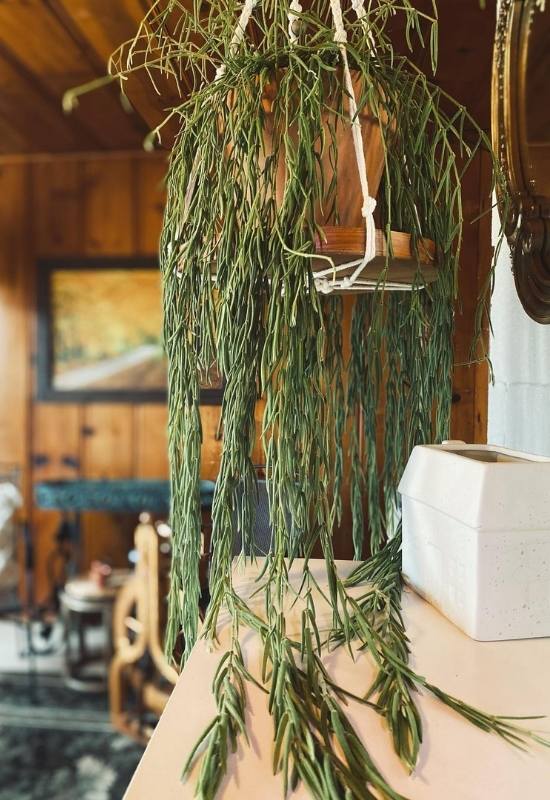
The Latin name of this vine means “linear hoya” because of a very distinctive feature of this houseplant. In fact, the leaves are not elliptical at all.
You will see what looks like a series of green beans hanging from baskets, because the foliage is thin, long, and elegantly curved. It is also slightly fuzzy, but you won’t notice it from a distance.
The leaves grow alternately on very thin, green, draping vines. What is more, the flowers are fully white with a dash of lemon yellow in the middle. They appear in small but very bright, hanging inflorescences. This is the variety you want for a light and breezy look, even in a minimalist environment.
Natural or cultivar: natural.
Flower color: white with a dash of lemon yellow.
Flower size: small.
Plant size: up to 6.5 feet long (2.0 meters).
Suitable for outdoor growing: no.
6: Imperial Hoya (Hoya imperialis)

Imperial hoya, or Hoya imperialis, has some of the largest flowers of all plants in this genus. They can reach 3 inches across and grow in clusters of 1 to 19.
But it is not just the size that makes them stand out. The blooms are deep ruby red with cream-white coronas in the middle.
They are also very waxy and appear almost succulent. This gives you an exotic and very energetic display.
The leaves are thick, fleshy, mid-green, and 2 to 6 inches long and 1 to 2 inches wide.
It has all the beauty of tropical houseplants, perfect for large displays. It is also a fast-growing vine, sometimes hard to keep up with.
Natural or cultivar: natural.
Flower color: ruby red with cream corona.
Flower size: large, up to 3 inches across (8.0 cm).
Plant size: 8 to 15 feet long (2.4 to 4.5 meters).
Suitable for outdoor growing: yes, but only in zones 9 to 11.
7: Hoya Retusa (Hoya retusa)

Hoya retusa is another original-looking variety of this vine for two reasons. To start with, the leaves are long, thin, and have a flat tip.
They look like strings of deep emerald green with lighter specks on them, and they are particularly glossy, excellent for creating light effects.
The flowers are medium-sized, white with a purple-red corona, and they do not always grow in umbels. In fact, they often open individually, looking sideways and slightly down.
This makes it ideal for a high position in your house or office, like on top of a shelf or cupboard, where it will provide excellent decoration and soften hard edges.
Natural or cultivar: natural.
Flower color: white and purple red.
Flower size: medium.
Plant size: up to 6 feet long (1.8 meters).
Suitable for outdoor growing: not usually.
8: Hoya Obovata (Hoya obovata)

Hoya obovata has unique foliage that sets it apart from other varieties. The leaves are very fleshy, almost succulent, and usually ovate, not elliptical. You do get the odd one that is parted in the middle, like a heart.
They are glossy and bright emerald green with lighter specks decorating them. The vines are quite strong and silver-green, and the umbels nod from them with very bright flowers.
In fact, they are a strange white with a pink undertone and deep magenta centers. This is a very sculptural houseplant with a very exotic and showy presence and personality, ideal for bright rooms.
Natural or cultivar: natural.
Flower color: white pink with deep magenta.
Flower size: small.
Plant size: 12 to 20 feet long (3.6 to 6.0 meters); easy to prune.
Suitable for outdoor growing: no, you would need a greenhouse because it is delicate.
9: ‘Lisa’ Hoya Australis (Hoya australis ‘Lisa’)

Hoya australis ‘Lisa’ is the waxplant you want for its unique foliage coloring and pure white blooms.
The elliptical leaves, glossy like all waxflowers, are variegated. They have a bright yellow-green center and then patches that become progressively darker towards the margin, until you get a very dark shade at the very edges.
You may even see some pink overtones in the right conditions. The fragrant blooms on the green to purple vines have longer petals compared to other varieties, and they create a wonderful contrast with their snow-white color.
Natural or cultivar: cultivar.
Flower color: snow white.
Flower size: medium small.
Plant size: 3.5 feet long (approximately 1.0 meters).
Suitable for outdoor growing: no.
10: Hoya Wayetii (Hoya wayetii)

Hoya wayetii is another variety you will very much appreciate for its foliage. The leaves are long, leathery, pointed, and very glossy, looking like canoes.
They form exotic-looking and lush, shrub-like clumps of mid-emerald green, but also with other tints like lime and even some copper tones.
The umbels contain small flowers with joined petals, like small pentagrams. They are lemonade pink on the outside and dark ruby purple in the middle.
This is a super elegant vine with a very fine and original texture, truly reminiscent of rainforests and lush exotic places.
Natural or cultivar: natural.
Flower color: lemonade pink and ruby red.
Flower size: small.
Plant size: 3 feet long (90 cm).
Suitable for outdoor growing: yes, this is a variety that loves open air, though only in USDA zones 11 or above.
11: Hoya Macrophylla (Hoya macrophylla)
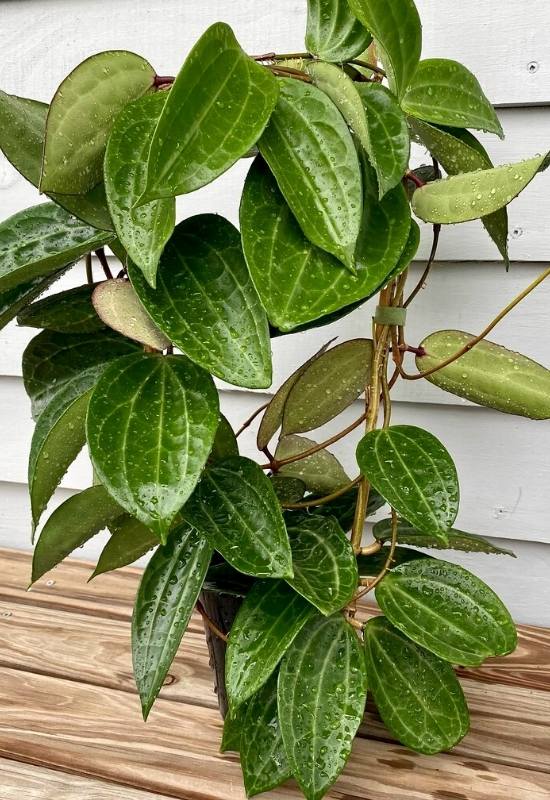
Hoya macrophylla is distinguished by its huge foliage. The leaves are 6 to 8 inches long and 2 to 3 inches wide.
They are fleshy, glossy, and colorful as well. This species has a beautiful pattern of raised veins that cut through the rich green of the background.
These veins are of a lighter shade, providing both texture and color. There are also variegated varieties like Hoya macrophylla albomarginata, with cream-white edges, or Hoya macrophylla variegata with yellow stripes along the margins.
The flowers have long, white petals with pink blushes and they come in clusters of up to 30. These qualities make it an excellent houseplant.
Natural or cultivar: natural.
Flower color: white with pink blushes.
Flower size: medium.
Plant size: up to 4 feet long (1.2 meters).
Suitable for outdoor growing: it is mainly am indoor plant but you can grow it outdoors in zones 10 to 11.
12: Hoya Coronaria(Hoya coronaria)

Hoya coronaria is a waxplant with bright, mid-green leaves that have a soft fuzz on them. They are broad, fleshy, and slightly curved, like a paddle.
On the underside, you will notice a straight rib running across the whole leaf. They are 6 inches long and 3 inches wide.
The blooms are also medium-large, about 1.5 inches across, and they are particularly hard to the touch.
They look like starfish, with pointed petals, and come in small clusters. The blooms can be of different colors: white with canary yellow coronas, yellow, pink, red, and sometimes with yellow tips or even maroon. This is a very showy variety for indoor spaces or tropical gardens.
Natural or cultivar: natural.
Flower color: white, yellow, pink, red, maroon, purple.
Flower size: medium large (1.5 inches or 4.0 cm).
Plant size: up to 10 feet long (3.0 meters).
Suitable for outdoor growing: yes, in USDA zones 11 and above.
13: Hoya Finlaysonii (Hoya finlaysonii)

If you could give a common name to Hoya finlaysonii, it would be “crocodile waxplant.” The leaves are best described as resembling alligator skin.
Waxy but thin, they have a pattern of darker green lines against a paler but rich green background. They are long (6 inches) and pointed, and they grow on light brown vines that look quite hard rather than soft.
The flowers come in spherical umbels, packed with many blooms. Each has orange to purple margins, while the corona can be white or even yellow. These “balls of blooms” among the very decorative foliage with its exotic texture make it a very prized houseplant.
Natural or cultivar: natural.
Flower color: orange, purple, white and yellow.
Flower size: small.
Plant size: up to 5 feet long (1.5 meters).
Suitable for outdoor growing: yes, in zones 10 and above, but it is better as a houseplant.
14: Hoya Pachyclada (Hoya pachyclada)
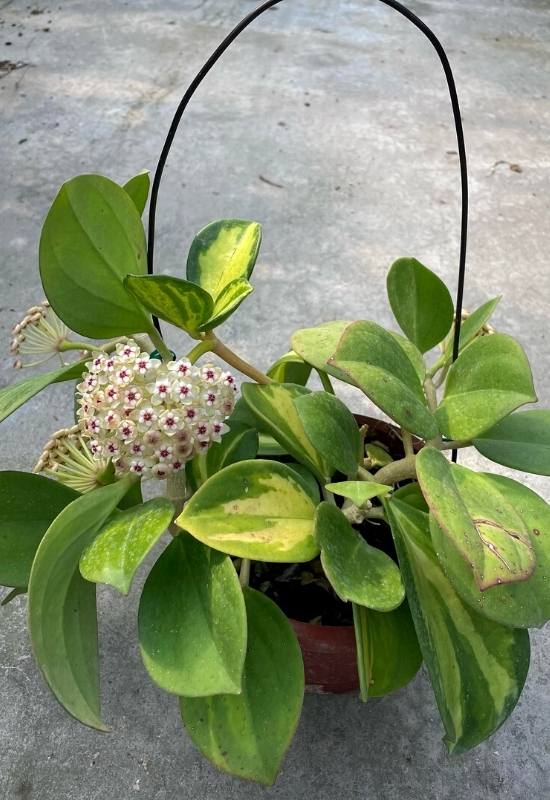
The name of this waxflower, Hoya pachyclada, describes this plant perfectly, as it means “with thick branches.”
Indeed, this is an almost succulent variety, with large, broad, and very fleshy leaves that have a delicate, slightly pointed tip.
They are a delicate shade of matte jungle green, though they can also be light emerald green. This may depend on the light conditions; in fact, some plants even take on purple shades. It is also a small and very slow-growing species.
The blooms come in thick, nodding umbels of up to 30. They are fleshy, glossy, and snow-white. While it looks like a succulent, it will need regular watering, like all other plants of this genus.
Natural or cultivar: natural.
Flower color: snow white.
Flower size: small.
Plant size: up to 2 feet long (60 cm).
Suitable for outdoor growing: yes but only in zones 11 and above.
15: Hoya Fitchii (Hoya fitchii)

Hoya fitchii has unique patterns on its foliage that make it very delicate, elegant, and fine-looking.
The leaves are pointed, fairly broad, and light fern green in color, but they also have a pattern of almost white lines, like a cobweb, that gives it an amazing texture.
These grow fairly spaced on the thin but strong vines and are best admired up close, like on a coffee table or work desk.
The blooms have an almost translucent quality and range from watermelon to peach pink, sometimes with an accent of purple on the tips. Each umbel can have about 24 little blossoms. It is also easy to train to grow upwards.
Natural or cultivar: natural.
Flower color: watermelon, peach and purple.
Flower size: small.
Plant size: up to 2 feet in height (60 cm).
Suitable for outdoor growing: usually grown indoors, but in zones 10 and 11 it can grow outdoors too.
16: Hoya Memoria (Hoya gracilis)

The Latin name of Hoya memoria, Hoya gracilis, describes it perfectly. It means lean, slender, or slim.
This look comes from the thick foliage, which is made up of hard, long, and pointed elliptical leaves that are dark green with brighter specks, improving its texture.
Each leaf can grow to about 4 inches long. They grow on thin, trailing branches, adding to the elegant effect.
The flowers are very small and come in umbels of about 20. They are light watermelon pink with purple-red coronas, and the petals reflex as they mature.
Overall, this is a delicate-looking plant, ideal for adding a touch of sophistication to any tidy living or working space.
Natural or cultivar: natural.
Flower color: watermelon and red purple.
Flower size: very small.
Plant size: up to 12 feet long (3.6 meters).
Suitable for outdoor growing: usually grown indoors.
17: Hoya Shepherdii (Hoya shepherdii)

Hoya shepherdii has unmistakable foliage. Each leaf is very long and thin, like a blade of grass, and they grow in opposite pairs on soft vines.
With a minimum length of ¼ inch and a maximum of 12 inches, you also get a lot of variety in the texture.
These are usually green, ranging from mid to dark, but some plants even take on a dark blue tint, which makes them truly exceptional.
The flowers can be snow-white, but sometimes they have a very pale lime or cream-yellow tint. The center of the corona is darker, either red or saffron. The petals are wide and then taper to a thin tip. Overall, it has an exotic but also elegant, delicate look.
Natural or cultivar: natural.
Flower color: white, cream or lime yellow with red or orange in the corona.
Flower size: medium small (0.8 inches, or 2.0 cm).
Plant size: up to 6 feet long (1.8 meters).
Suitable for outdoor growing: it likes to spend summers outdoors.
18: Hoya Affinis (Hoya affinis)

Hoya affinis has an upright habit, so it is easy to train it on trellises and stakes. The leaves are thick, fleshy, and succulent-like, usually a bright emerald shade, but the color can change according to light conditions.
Each can be about 3.5 inches long and about 1.7 inches wide. The waxy flowers can be of many different colors.
The bright, fiery red varieties are the most common, but the range is huge, from coral to deep purple, including maroons and pinks.
The petals are pointed, and the corona is always a different hue from them. And the umbels can have 10 to 12 heads each.
Natural or cultivar: natural.
Flower color: many, usually fiery red, but of a wide range.
Flower size: medium, 2 inches wide (5.0 cm).
Plant size: up to 5 feet tall (1.5 meters).
Suitable for outdoor growing: usually grown indoors, but you can have it outdoors in USDA zones 10 or above.
19: Hoya Multiflora (Hoya multiflora)
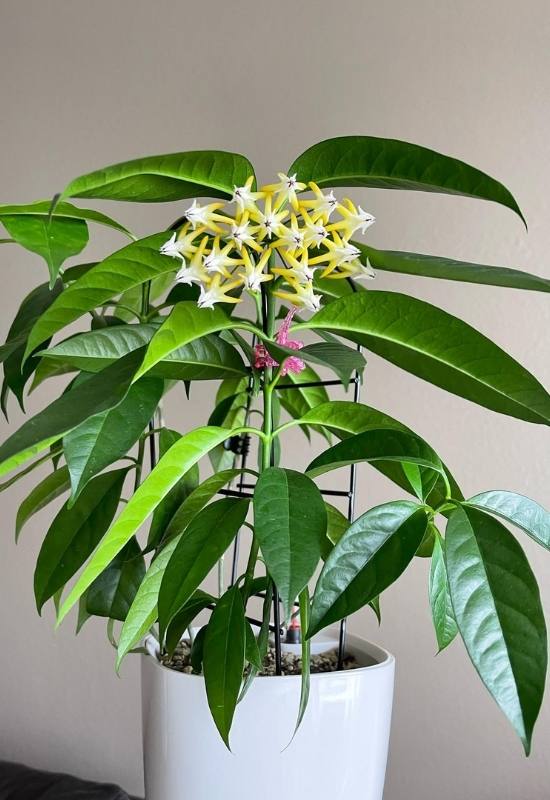
Hoya multiflora is a very distinctive waxplant with dark foliage and unusual blooms. It looks like it would fit well in a forest, even a temperate one.
The foliage is long, elliptical, and pointed, arching and dark green. The leaves are large, up to 8 inches long and 3 inches wide.
They also have a waving quality to them. The flowers are truly unique. They look like arrows because the petals are very reflexed, pointing literally backward. They are white or yellow, ranging from lemon to saffron.
The corona, on the other hand, extends forward and is white. For this reason, the clusters form an intricate pattern, like you would expect in a Gothic cathedral. Of all the waxflowers you can grow indoors, multiflora is among the most sculptural.
Natural or cultivar: natural.
Flower color: white and yellow.
Flower size: small.
Plant size: up to 8 feet long (2.4 meters).
Suitable for outdoor growing: no.
20: Hoya Sigillatis (Hoya sigillatis)

Hoya sigillatis will form a dense clump of lush foliage that trails and drapes beautifully from hanging baskets.
The leaves are elliptical and elongated, but what makes the texture fantastic is the variegation of dark and light green patches that balance with great harmony.
However, with the right light conditions, this combination can shift to the red scale. The vines are brown and semi-hard.
The blooms are small, with joined and partly reflexed petals that form an orange pentagon with lovely yellow star rays in the middle.
The umbels have an open habit and usually occur at the tips of the vines, hanging down under the plant. As a houseplant, this variety of waxflower has great qualities, and you can also grow it outdoors.
Natural or cultivar: natural.
Flower color: orange with some yellow.
Flower size: small.
Plant size: up to 4 feet long (1.2 meters).
Suitable for outdoor growing: yes, in USDA zones 10 and above.
21: Variegated Hoya Acuta (Hoya acuta variegata)

Hoya acuta variegata is a climbing variety of waxflower and one of the easiest to grow. The leaves are ovate with soft, round tips. The middle is bright lime green, while the margins are mid-emerald green.
But this is not the only reason why it is an excellent and decorative houseplant. The umbels are very thick and can even form a spherical cluster of tightly packed little flowers.
Star-shaped and waxy as you would expect, these are white with pink coronas, or sometimes yellow. This cultivar is one of the most popular on the market, also because it is a generous bloomer and one of the least troublesome of all the waxplants.
Natural or cultivar: cultivar of Hoya acuta.
Flower color: white with pink or yellow.
Flower size: small.
Plant size: 8 to 10 feet tall when adult (2.4 to 3.0 meters).
Suitable for outdoor growing: yes, in USDA zones 10b and above.
22: Hoya Pauciflora (Hoya pauciflora)
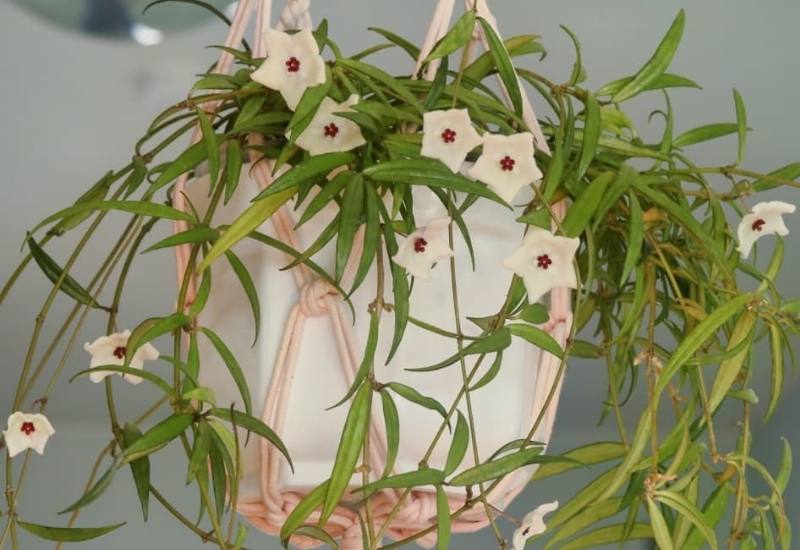
This waxflower species is called Hoya pauciflora because its leaves are very small. In fact, it must be one of the varieties with the least thick foliage.
They are light green, with a rib in the middle, and 1 to 3.5 inches long but very thin. You only get a pair at each node of the soft and draping vines. But there is more that makes this type of waxplant distinctive.
The blooms appear individually and not in clusters. They are very fragrant and star-shaped, fleshy, and pure white with deep, dark purple coronas.
They are very visible among the thin foliage and hang facing outwards for a perfect, elegant but showy effect.
Natural or cultivar: natural.
Flower color: white with deep and dark purple.
Flower size: medium, up to 1.6 inches wide (4.0 cm).
Plant size: up to 6 feet long (1.8 meters).
Suitable for outdoor growing: no.
23: ‘Langkelly Ck.” Waxflower (Hoya macgillivrayi ‘Langkelly Ck.’)
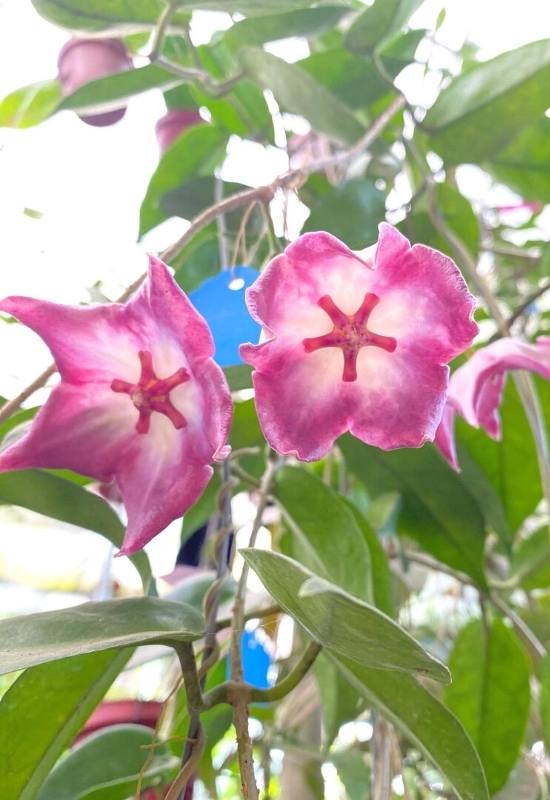
‘Langkelly Ck.’ waxflower, a cultivar of Hoya macgillivrayi, is chosen for its amazing blooms. They are large and super showy.
They have a light purple center, and the margins are a very deep, dark purple. They also have a strange, cupped shape with five points, like decorative saucers, and they are huge.
Each can reach 2.7 inches across, and the clusters can be 10 inches in diameter. What is more, they are very, very fragrant.
The glossy leaves are elongated, ovate, bright green, and pretty. However, the winning factor of this variety is certainly its spectacular blossom.
Natural or cultivar: cultivar.
Flower color: light and deep dark purple.
Flower size: large (2.7 inches or 7.0 cm across).
Plant size: up to 5 feet tall (1.5 meters).
Suitable for outdoor growing: no.
24: ‘Speckles’ Waxplant (Hoya kerrii variegata ‘Speckles’)
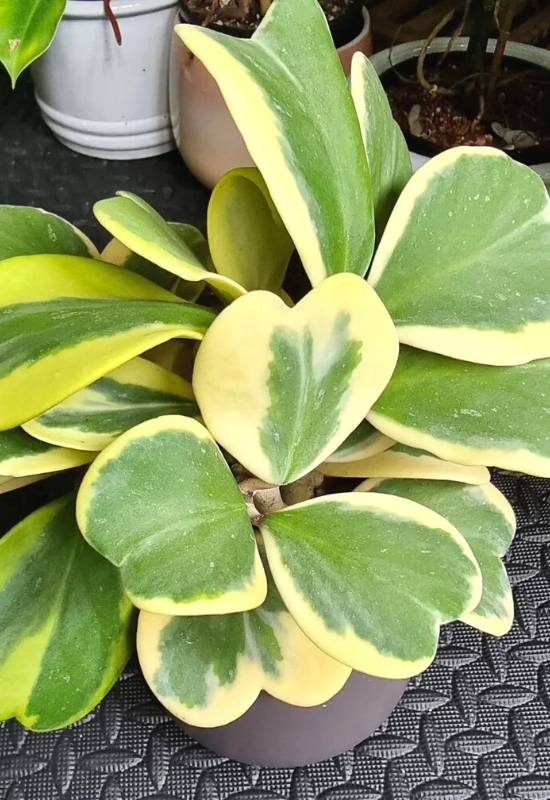
For a waxplant cultivar with very unusual foliage, consider Hoya kerrii variegata ‘Speckles’. The leaves are heart-shaped, very fleshy, and almost succulent, up to 3.5 inches long and broad as well.
They are extremely glossy, and what is more, they have three different shades of green in them, starting with very pale in the middle, then pea green, and finally mid to dark emerald towards the edges.
It is a small plant, and each umbel of flowers will have up to 30 blooms with white joined petals that form rounded pentagons and purple coronas in the middle. This slow-growing variety is ideal as a centerpiece for an elegant coffee table.
Natural or cultivar: cultivar of Hoya kerrii.
Flower color: white and purple.
Flower size: small.
Plant size: 2 feet long (60 cm).
Suitable for outdoor growing: no.
25: Hoya Cystiantha (Hoya cystiantha)

Hoya cystiantha is a variety you will love for its large, fragrant, and unusual flowers.
The blooms are cup-shaped and look like pretty, deep bowls. This sets them apart from all other species and cultivars.
They are a lovely cream color, sometimes edging towards butter. The corona in the middle is visible and star-shaped, with five very tiny purple dots.
They come in umbels of up to 20, and each blossom lasts for about two weeks. The leaves are mid-green, elliptical, and 5 inches long.
They are thin, glossy, and arranged in opposite pairs along the green stems. The unusual shape of the flowers makes it a very exotic presence for indoor spaces.
Natural or cultivar: natural.
Flower color: cream white.
Flower size: large, 1.6 inches across (4.0 cm).
Plant size: 3 feet long (90 cm).
Suitable for outdoor growing: no.
26: ‘Purple Pride’ Waxplant (Hoya carnosa variegata ‘Purple Pride’)
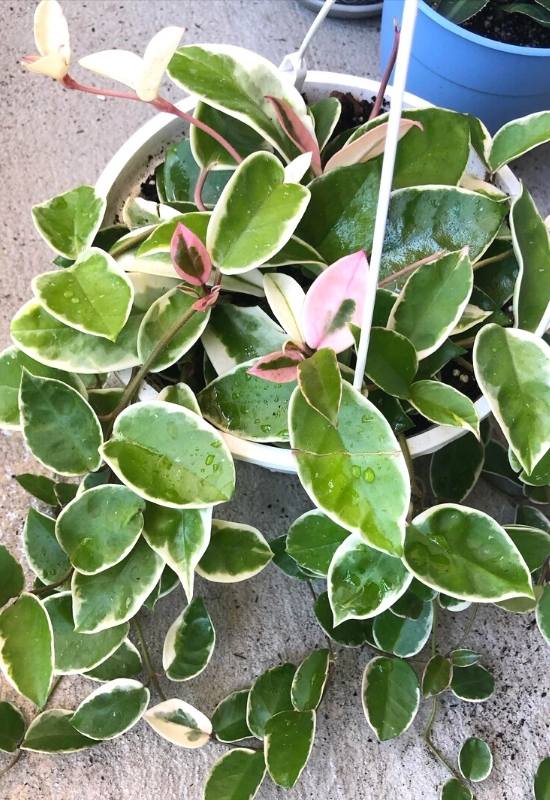
‘Purple Pride’ waxplant is a cultivar of Hoya carnosa variegata with very distinctive and colorful leaves, perfect for a bright and eye-catching display all year round.
The leaves are very fleshy and semi-succulent indeed. They are also long (3 inches), broad, elliptical, and glossy.
They are mostly cream-white and mid-green, but with sunlight, they also take on pink-purple shades, very unusual for a waxvine.
The blooms are felted, star-shaped, and pink in color with a plum corona. They will delight you with their light but sweet smell. They will come in clusters of about 30 and will last for about a week.
Natural or cultivar: cultivar of Hoya carnosa.
Flower color: pink and plum purple.
Flower size: small to medium, 0.7 inches across (1.8 cm).
Plant size: up to 20 feet long (6.0 meters), but slow growing and easy to prune.
Suitable for outdoor growing: yes, in zones 9 to 11; in fact, the purple coloring gains with sunlight.
27: Hoya ‘Bella’ (Hoya lanceolata ssp bella)

‘Bella’ waxflower is a subspecies of Hoya lanceolata and a very elegant plant indeed. The leaves are spear-shaped (lanceolate) and pointed, light to mid-green. They come in opposite pairs on the long, thin, straight, and fresh-looking vines, which drape over containers with sophisticated beauty.
They are small, only about 1 to 1.2 inches long, but this adds to the open and breezy look of this waxplant.
The blooms are star-shaped and small. They come in nodding umbels of 10 to 30 that tend to concentrate at the end of the stems.
It is ideal for an airy room with lots of light, where it will bring its fine texture and bright blossoms. It is also a fairly small variety, suitable for modest spaces. However, this plant is delicate and sometimes demanding, so keep this in mind.
Natural or cultivar: natural.
Flower color: white and purple.
Flower size: small.
Plant size: 18 inches long (45 cm).
Suitable for outdoor growing: no.
28: ‘Indian Rope’ Waxplant (Hoya compacta ‘Indian Rope’)
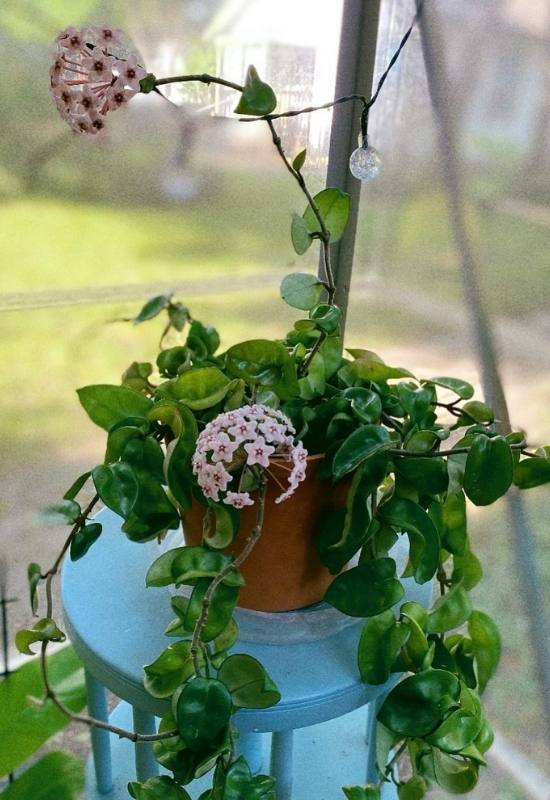
‘Indian Rope’, a cultivar of Hoya compacta, will strike you with the odd shape of its foliage. The glossy and fleshy leaves are cupped and they twist and curl, which is a very original feature for waxplants.
What is more, this species has very, very dense foliage, and you will not even be able to see the stems. Finally, they are variegated, with white, pale green, and mid-green.
However, with light, they can take on coral and pink shades too. The flowers have the typical star shape of waxflowers, white with a red corona.
Small and pretty, they come in umbels of up to 50, arguably some of the most numerous of all waxvines. This houseplant is a living sculpture, ideal for a central place in a living room or office.
Natural or cultivar: cultivar.
Flower color: white and red.
Flower size: small.
Plant size: up to 20 feet (6.0 meters) outdoors, only 4 to 6 feet indoors (1.2 to 1.8 meters).
Suitable for outdoor growing: only in USDA zones 10 to 12.
29: Hoya Sussuela (Hoya sussuela)

Hoya sussuela is yet another climbing variety with a very individual look and personality. The climbing vines are soft-looking and green, the same color as the foliage.
But the leaves, which are elliptical with a tiny tip, slightly felted, fairly fleshy, and glossy, are very much spaced out along the stems.
The slender and airy look of the body of this waxplant is contrasted by the bold and large blooms.
The flowers are star-shaped, up to 2 inches across, and of the deepest maroon color, very glossy and impossible to miss, while the corona is usually yellow.
They also have an original fragrance for waxflowers, as it is musky and very strong. They will open in small clusters of between 3 and 5 heads each.
As a houseplant, it will mark your originality and grace your rooms with both elegance and showy blossoms.
Natural or cultivar: natural.
Flower color: maroon and yellow.
Flower size: large, 2 inches across (5.0 cm).
Plant size: up to 30 or 40 feet long outdoors (9 to 12 meters) but easy to prune.
Suitable for outdoor growing: yes, in USDA zones 11 and above.
30: Hoya Curtisii (Hoya curtisii)

Hoya curtisii is a compact variety of waxplant with very dense and finely textured foliage. The leaves are unusually shaped, with matching width and length, about ½ to 1 inch.
They are almost round with a lovely tip at the end, a bit like a spade in cards. Add the beautiful and fine variegation of lighter and darker greens in small dots, and you understand why this plant will add texture and color to your rooms.
The blooms are quite unusual as well. The petals are like spikes, very thin, and they reflex as they mature.
The corona, with purple and pink shades, remains at the forefront of the clusters, with up to 30 heads, forming a very elegant and three-dimensional decoration.
Natural or cultivar: natural.
Flower color: off white, with a light yellow glow and with pink and purple coronas.
Flower size: small.
Plant size: about 1 foot long (30 cm).
Suitable for outdoor growing: yes, in USDA zones 10 and above.
31: Hoya Odorata (Hoya odorata)

Hoya odorata is one of the most elegant varieties of waxplant, and one with a distinctive smell, as the name suggests.
The thin and arching vines do not grow downwards like in many waxflowers, but spread out before descending.
The leaves are mid to dark green, elliptical, and glossy but not fleshy, fairly spread out, and in opposite pairs.
The flowers have a strong fragrance of citrus, and the colors match it. White and star-shaped, with long petals and a lemon-yellow center, they will come in small and open clusters along the vines.
It is a small species, harmonious in shape, and with a good symmetrical texture. I would suggest it for a bright and breezy room, where it can really fit in with its look and aroma.
Natural or cultivar: natural.
Flower color: white and lemon yellow.
Flower size: small.
Plant size: 1 to 2 feet in length (30 to 60 cm).
Suitable for outdoor growing: yes, in USDA zones 10 and above.
32: Hoya Meredithii (Hoya meredithii)

The main decorative quality of Hoya meredithii is the pattern of its variegated foliage. The leaves are bright and light green with an intricate pattern of darker veins that looks like filigree.
They are broad and pointed, often curving slightly, and quite large in size, 4 inches wide and up to 8 inches in length.
This lush display will also host thick umbels of waxy flowers that have the typical shape of the blooms of waxplants. The petals are canary yellow, while the coronas are lighter.
This waxflower is perfect as a houseplant, giving you a similar effect to that of a climbing philodendron.
Natural or cultivar: natural.
Flower color: canary yellow.
Flower size: small.
Plant size: up to 10 feet tall (3.0 meters).
Suitable for outdoor growing: yes, in zones 10 and above, but mainly grown as a houseplant.
33: Hoya Caudata Sumatra (Hoya caudata sumatra)

Hoya caudata sumatra is a rare variety of waxplant with distinctive fluffy flowers. The small blooms are star-shaped, white with a purple corona, but covered in a very soft white fuzz.
They will open in umbels of about a dozen heads each. The vines are brown and hairy as well. The leaves are ovate, 2 to 6 inches long and up to 3 inches wide.
However, what makes them unique is the coloring. They have a darker shade as a background, with brighter dashes that look like sanding.
They are usually green, but in some cases, they turn into a very dark shade of purple. This is a very expensive plant, given its rarity, and you can only find it in very specialized shops.
Natural or cultivar: natural.
Flower color: white and purple.
Flower size: small.
Plant size: up to 10 feet tall (3.0 meters).
Suitable for outdoor growing: yes, in USDA zones 11 or above.
34: Hoya Hellwigiana (Hoya hellwigiana)

Hoya hellwigiana offers your home or garden broad and long leaves with veins in clear relief and a little twist. Reaching 5 inches long and 2.5 inches wide, these are usually mid-green but can turn red and even purple if this waxplant gets enough light.
The umbels contain up to 30 flowers each, with a distinctive smell of lemon, so very fresh indeed. The petals look soft and like candle wax.
They are cream in color and will reflex very harmonically, leaving the white coronas on the outside of the clusters, which can be spherical in shape.
Giving you a three-dimensional bloom and colorful foliage, this waxflower has the best of both worlds.
Natural or cultivar: natural.
Flower color: cram and white.
Flower size: small.
Plant size: up to 12 feet tall (3.6 meters).
Suitable for outdoor growing: yes, in USDA zones 11 and above.
35: Hoya Krohniana (Hoya krohniana)
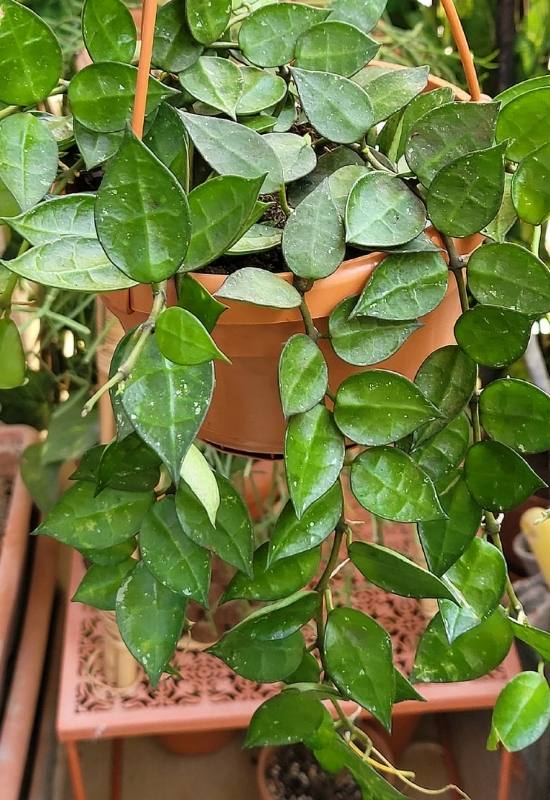
If you like heart-shaped foliage, you will love Hoya krohniana. This waxplant has small, cordate leaves that grow elegantly in opposite pairs on the soft stems.
They are light green but with even brighter tiny specks or dots on them, and fairly fleshy. Some varieties, like the cultivar ‘Super Eskimo’, are basically cream-white with dark green points on them.
The flowers have a softened pentagonal shape, almost round, with thick petals covered in a shiny white fuzz. They look like they are covered in dew all the time. The coronas are golden to lemon yellow.
The blossoms have a very strong fragrance, especially at night. This is a small, trailing variety that can give you lots of sweetness both indoors and outdoors.
Natural or cultivar: natural.
Flower color: white and yellow.
Flower size: small.
Plant size: 2 to 3 feet long (60 to 90 cm).
Suitable for outdoor growing: yes, in zones 10 and above, one of the best varieties to grow outdoors.
36: Hoya Padangensis (Hoya padangensis)

Hoya padangensis has a very slender and elegant look in both its foliage and blooms. The leaves are mid-green and thin, with slightly lighter patches on them.
Each can reach 5 inches long and only 1.4 inches in width. They arch beautifully and have a pointed end, growing spaced on the climbing vines.
This theme is repeated in the flowers, which have pointed and long petals that curve inward. With delicate pink to purplish tips, the flowers are white, and the coronas are yellow.
The umbels are airy, open, and with only up to 8 blossoms each. This variety of waxflower is ideal for open, light-filled rooms with a smart and even minimalist design.
Natural or cultivar: natural.
Flower color: white, pink, cream, light purple and yellow.
Flower size: small.
Plant size: up to 10 feet tall (3.0 meters).
Suitable for outdoor growing: yes, in USDA zones 10 and above.
37: ‘Black Dragon’ Waxflower (Hoya pubicorolla ssp. anthracina ‘Black Dragon’)
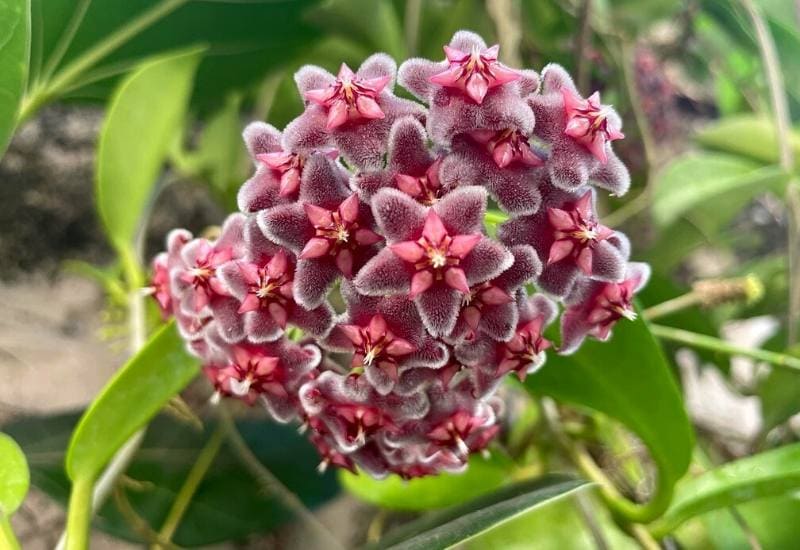
‘Black Dragon’ is a variety of waxflower that takes its name from the amazing color of its blooms.
The star-shaped flowers have a deep burgundy shade, which reflects light like a precious and rare gemstone, and it is almost black in gardening terms.
The petals also have a white fuzz on the margins that heightens the effect, while the coronas have ivory, red, and pink-purple in them.
The umbels are very thick and spherical, with up to 30 heads each. The leaves are long, elliptical, and pointed, fairly glossy and mid-green.
Each can reach 5 inches long and will also arch lightly. This climber is regarded as the darkest of all waxplants and will bring a gothic look to your living room or office.
Natural or cultivar: cultivar of Hoya pubicorolla ssp.anthracina, a species with dark flowers.
Flower color: “black” or very dark burgundy purple with ivory, red and pink purple.
Flower size: small.
Plant size: up to 10 feet tall (3.0 meters).
Suitable for outdoor growing: no.
38: Hoya Merrillii (Hoya merrillii)

Hoya merrillii is a waxvine with very decorative foliage. The leaves will form denser clumps at the base of the vine. They are oval, broad, and paddle-shaped, fairly fleshy, and incredibly glossy.
You will see green shades that range from light to avocado green, but this plant may even surprise you with wine-red hues with good sunlight. Beautiful, lighter veins will add interest to this display.
They are very large, up to 1 foot in length and 8 inches in width. This is a climbing variety, and the flowers are star-shaped with long petals, usually yellow, from lemon to golden and even mustard, but in some varieties, cream, white, and faint pink.
They are arranged in spherical clusters of up to 30. This is one of the most generous waxflowers, ideal as a houseplant for its showy appearance.
Natural or cultivar: natural.
Flower color: yellow, white, pale pink.
Flower size: small.
Plant size: up to 10 feet tall (30 cm).
Suitable for outdoor growing: yes, in USDA zones 11 and above, but more suitable as a houseplant.
39: Hoya Latifolia (Hoya latifolia)

The scientific name Hoya latifolia means “broadleaf waxplant,” and it is a fitting description. The leaves are, in fact, very wide, up to 6 inches, and even long, from 10 to a whopping 25 inches.
On top of this, they are slightly heart-shaped, fleshy, very glossy, and have beautiful veins on them. Their color is quite dark, depending a bit on light exposure, however.
The spherical umbels are record-breaking too, with up to an amazing 260 individual flowers each.
The blooms can be of different colors in the white to pink-purple range, usually with darker coronas. This is a record-breaking climbing variety of waxflower, sure to wow your guests.
Natural or cultivar: natural.
Flower color: from white to pink purple.
Flower size: small.
Plant size: usually up to 5 feet when grown as a houseplant (1.5 meters) up to 12 feet when outdoors (3.6 meters).
Suitable for outdoor growing: yes, in USDA zones 10 and above.
40: Hoya Callistophylla (Hoya callistophylla)

If you look at Hoya callistophylla, snakes may come to mind. The leaves are divided like scales by dark green stripes that follow the veins, cutting over a much lighter background.
They are elliptical, long, and pointed, not fleshy but glossy, and they also arch slightly. The contrasting effect is striking and decorative, and consider that they can be 10 inches long.
This climbing waxflower will also bloom with round umbels of very colorful flowers. Containing up to 30 each, the petals are deep purple at the tips, red in the middle, and yellow towards the center. The coronas are usually cream-white. This is the waxflower of contrasting colors for a very dramatic effect.
Natural or cultivar: natural.
Flower color: deep purple, red, yellow and cream white.
Flower size: small.
Plant size: up to 16.5 feet tall (5.0 meters).
Suitable for outdoor growing: yes, but only in USDA zones 11 or above.
Hoya Or Waxflower: A Beautiful Vine!

Many people think that hoyas, or waxflowers, are all a bit the same, perhaps because many have small flowers. But now that you have seen these 40 varieties, you must admit that there are many different types of waxvines, and they are all absolutely beautiful.