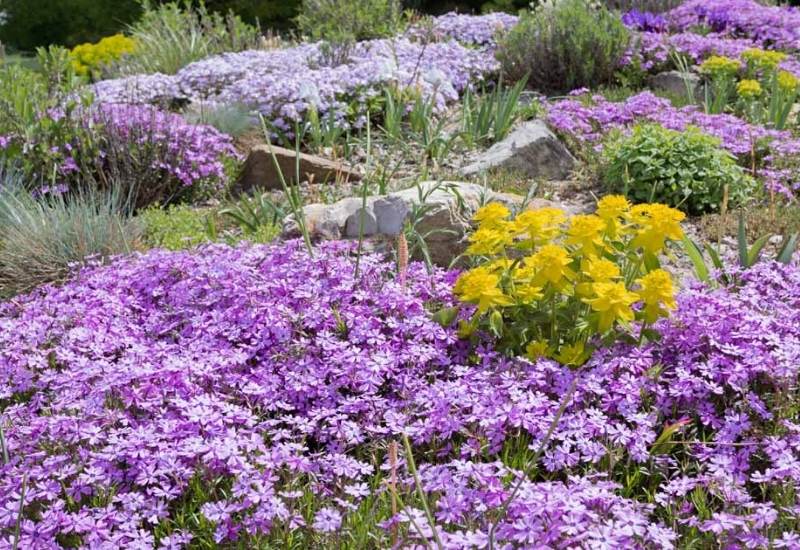
Transform your garden into a lush carpet of purple with low-growing, creeping ground cover plants. Purple, often seen as the color of royalty, brings an undeniable richness to any landscape. These flowering groundcovers will brighten your yard and give it a beautiful new dimension.
Some varieties thrive in full sun, like the vibrant creeping phlox, while others, such as periwinkle, bring life to shady spots under trees. Many are even evergreen, so when the blooming season ends, you’ll still have an attractive green blanket covering your land from spring to fall, and sometimes all year long.
To infuse your landscape with color year-round, choose hardy, evergreen perennials that offer high-impact blooms with minimal upkeep. You’ll find a wide spectrum of purple hues, from soft lilac and pale mauve to deep violet and rich burgundy. These plants are perfect for covering bare patches of soil, edging pathways and flower beds, decorating rock gardens, or growing between stepping stones.
Ready to explore the options? This list features 15 fantastic purple-flowering ground covers that deliver year-round appeal without requiring constant care. Prepare to let purple reign in your garden!
Why You Should Choose Ground Cover Plants with Purple Flowers
The primary appeal of growing ground cover plants with purple blossoms is the sheer energy and vibrancy of the color. This spiritual and uplifting hue ranges from pale pastels like lavender and light mauve all the way to rich, strong shades like raspberry and imperial purple. With such variety, you can find a purple to complement any garden palette.
Purple is also a color that you can enjoy in abundance from the beginning of spring straight through to fall. This is unlike other colors, such as red, which can be scarce in the springtime. The long blooming season of many purple varieties means you can create a harmonious color scheme that lasts through multiple seasons.
Why You Should Grow Ground Cover Plants

The most obvious reason to grow ground cover plants is that exposed soil isn’t very attractive, and adding a splash of purple can be truly transformative. But the benefits don’t stop there.
Creeping and covering plants help the soil retain moisture and preserve its nutrients. In a way, they function like a much more attractive form of mulch. Most ground cover plants are also low maintenance, or even very low maintenance. This reduces the time you need to spend working in your garden while still providing a great display for you and your guests to enjoy.
Finally, ground cover plants often spread quickly and are budget-friendly. You don’t need to purchase enough plants to completely cover an area from the start. Just plant them in a scattered pattern, and they will soon fill in the space, saving you money in the process.
15 Great Ground Cover Plants with Purple Flowers
The wide array of purple shades can lend a serene yet majestic feeling to your landscape. Here are 15 wonderful ground cover plants with purple blossoms to consider for your garden.
1. Periwinkle (Vinca minor)

Periwinkle is a graceful, evergreen ground cover that produces lavender-colored blooms. Its flowers have iconic whirling petals with flat tips, making them look like tiny little fans. It is an excellent choice because it spreads rapidly and effectively suppresses weeds. It also grows well in nearly all light conditions, from full sun to full shade, making it a versatile option for any garden.
Many varieties are available, including major periwinkle (Vinca major), which has larger flowers around 1.5 inches wide, and the hardier lesser periwinkle (Vinca minor), which grows wild in most temperate climates. The foliage consists of elliptical, hard, dark green leaves on arching stems. You can also find variegated types with yellow and green leaves.
As a ground cover, periwinkle is a dependable choice. It propagates using stolons and will keep your garden looking lively all year. It’s a fantastic fit for most informal settings and also works beautifully in rock gardens.
Hardiness: Lesser periwinkle thrives in USDA zones 4 to 9, while major periwinkle is suited for zones 7 to 9.
Light exposure: It handles full sun, partial shade, or full shade.
Blooming season: You can expect flowers in summer and fall.
Size: Major periwinkle grows from 6 inches to 2 feet tall and spreads up to 2 feet wide. Lesser periwinkle is much shorter, at 4 to 6 inches tall with a spread of up to 2 feet.
Soil requirements: It prefers medium fertile, well drained soil, including loam, clay, chalk, or sand. It can handle a pH from mildly alkaline to mildly acidic and is tolerant of drought and rocky soil.
2. Creeping Thyme (Thymus serpyllum)

One of the most popular full-sun ground covers is creeping thyme, which flowers in a wide spectrum of purple shades, from pale lilac to raspberry, depending on the cultivar. It creates a literal sea of color, as the tiny but dense blooms completely cover the small shrub. This plant forms small, cushion-shaped bushes that also feature aromatic leaves.
This little beauty is also evergreen, so after the summer flowers have faded, your land will remain covered in a finely textured green carpet. It’s also a magnet for pollinators and butterflies due to its nectar-rich flowers, which adds another layer of life to the garden.
Creeping thyme is a very low-growing plant, which makes it perfect for planting between stepping stones, in rock gardens, and along the sides of pathways near your home. It’s an excellent choice for coastal gardens but is only suitable for sunny locations.
Hardiness: It is hardy in USDA zones 4 to 9.
Light exposure: This plant requires full sun.
Blooming season: Flowers appear in the summer.
Size: It grows 1 to 2 inches tall and spreads 1 to 2 feet wide.
Soil requirements: It does well in medium-rich loam, chalk, or sand-based soil with a pH from mildly alkaline to neutral. It is also tolerant of drought, rocky soil, and salt.
3. Creeping Phlox ‘Violet Pinwheels’ (Phlox ‘Violet Pinwheels’)

If you’re looking for unusual qualities in your ground cover, creeping phlox ‘Violet Pinwheels’ is an excellent option. For starters, it boasts the most vibrant shade of violet purple you can imagine, an almost electric hue full of energy. The flowers are star-shaped, and the plant produces so many of them that the foliage becomes completely hidden when in bloom.
This massive floral display happens much earlier than with other creeping phlox varieties, allowing you to enjoy a purple spectacle in the spring. After the show, you can still appreciate the dark green, needle-shaped leaves that will cover your soil until fall.
Creeping phlox ‘Violet Pinwheels’ is perfect for creating a strong, super-vibrant effect. It is small enough to fit into rock gardens and flower beds. It’s an ideal choice for a sudden burst of color that begins very early in the spring, bringing your garden back to life after winter.
Hardiness: This plant is hardy in USDA zones 4 to 8.
Light exposure: It needs full sun to thrive.
Blooming season: It blooms all through the spring.
Size: It reaches 5 inches in height and can spread 2 to 3 feet wide.
Soil requirements: It prefers humus-rich, well-drained, and consistently moist soil, including loam, chalk, or sand. It can handle a pH from mildly alkaline to mildly acidic and is salt tolerant.
4. ‘Birch Hybrid’ Bellflower (Campanula ‘Birch Hybrid’)
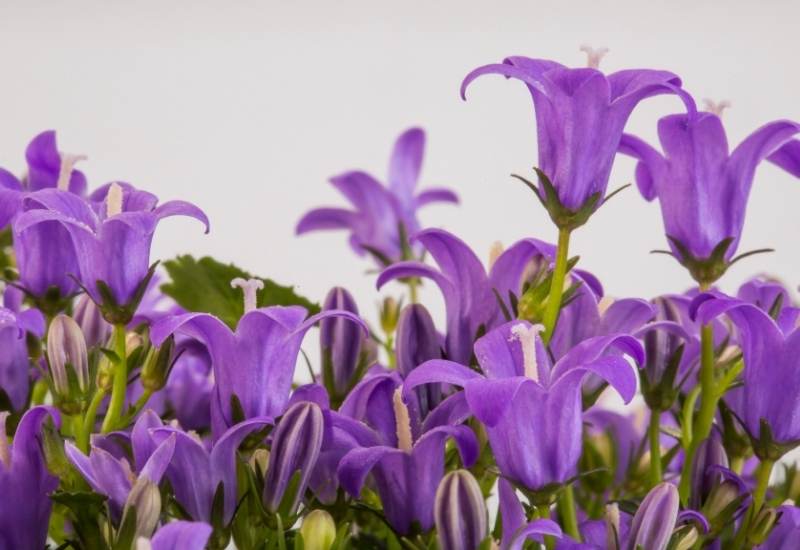
‘Birch Hybrid’ is a very low and spreading purple bellflower, which makes it a perfect ground cover. It is a vigorous plant that spreads naturally and quickly, making it excellent for a late-season burst of color and beauty. Its bell-shaped flowers appear in early summer and continue to bloom through the fall. The violet shade they possess is intense and eye-catching.
The blooms are not only long-lasting but also quite dense. They contrast beautifully with the dark green, broad, almost heart-shaped leaves that have gently spiny edges. You can enjoy the foliage all year round, as this plant is also evergreen.
Whether in full sun or more shaded spots, the ‘Birch Hybrid’ bellflower is a wonderful ground cover for all informal gardens. The blooms are quite showy, so it also works well in flower beds and rock gardens.
Hardiness: It thrives in USDA zones 4 to 9.
Light exposure: This plant does well in full sun or partial shade.
Blooming season: You can expect blooms from early summer through fall.
Size: It grows 4 to 6 inches tall and spreads up to 1 foot wide.
Soil requirements: It prefers medium fertile and regularly moist but well-drained soil, including loam, chalk, or sand. A pH from mildly alkaline to mildly acidic is best.
5. Carpet Bugleweed (Ajuga reptans)
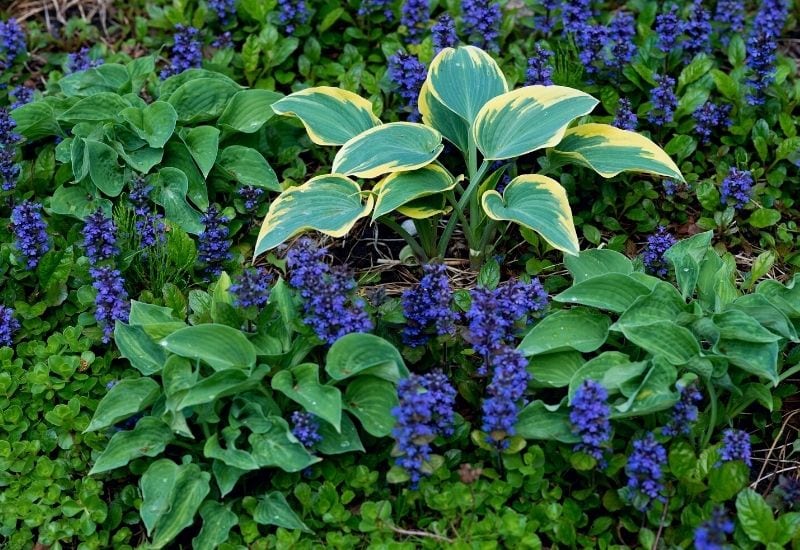
Carpet bugleweed is a fast-growing, shade-loving groundcover that will quickly blanket the ground with its dense violet-purple blooms. The flowers appear in upright spikes of packed, lavender-shaped heads. While small individually, their collective effect is impossible to miss. This floral show occurs very early in the season, after which the evergreen foliage remains as a decorative blanket all year long.
There are several varieties with different shades ranging from lavender to amethyst, as well as some blue cultivars. You might also choose the variegated ‘Burgundy Glow,’ which has pale cream-yellow and light silver-green leaves, or ‘Black Scallop,’ with its very dark purple foliage.
Carpet bugleweed is an ideal choice if you have difficult soil conditions, such as very sandy soil. It also tolerates shade well. You can plant it in containers and on slopes too.
Hardiness: This plant is hardy in USDA zones 4 to 9.
Light exposure: It grows well in partial or full shade.
Blooming season: Depending on the variety, it will bloom in spring or summer.
Size: It grows 3 to 6 inches tall and can spread from 1 to 3 feet wide.
Soil requirements: It needs medium moist and well-drained soil, including loam, clay, chalk, or sand. It prefers a pH from mildly alkaline to mildly acidic.
6. ‘Celeste’ Lithodora (Lithodora diffusa ‘Celeste’)
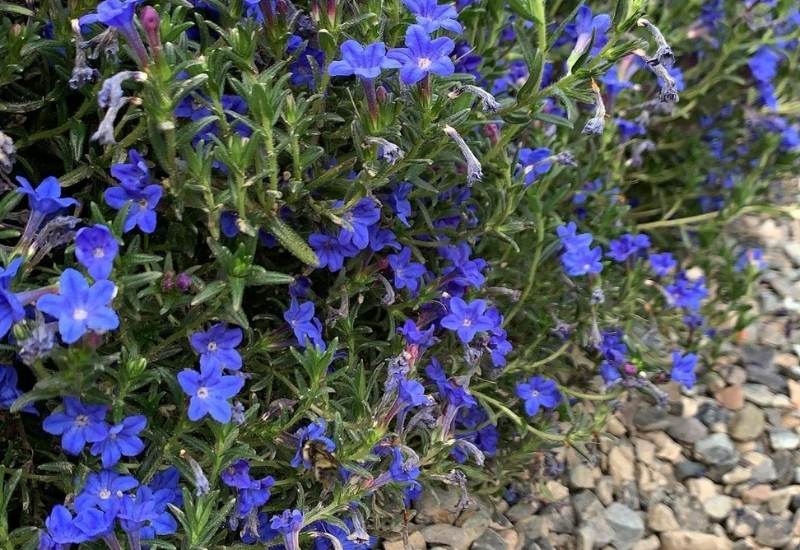
Lithodora is a mat-forming evergreen shrub that makes an excellent ground cover. While most varieties are in the blue range, ‘Celeste’ features lovely pure purple flowers that are quite vibrant and profuse. The blooms are star-shaped with five petals, well-proportioned, and slightly cupped.
Although the flowers are small, they are still fairly showy and attractive, appearing just above the green cushion of foliage. The evergreen leaves are bright green, thin, and long, arranged in rosettes on the stems, which gives the plant a very fine texture and creates lovely light effects. This spreading shrub forms charming cushions that will keep weeds out and protect the soil.
‘Celeste’ lithodora is perfect for informal gardens, edging, rock gardens, and along the sides of pathways. It can also be grown in containers, and propagating it is very easy.
Hardiness: It is hardy in USDA zones 5 to 7.
Light exposure: This plant thrives in full sun or partial shade.
Blooming season: It blooms from mid-spring through mid-summer.
Size: It grows to 4 inches tall and spreads 1 to 2 feet wide.
Soil requirements: It needs well-drained loam or sand-based soil with a pH from acidic to neutral and is drought tolerant.
7. ‘Queen Charlotte’ Sweet Violet (Viola odorata ‘Queen Charlotte’)
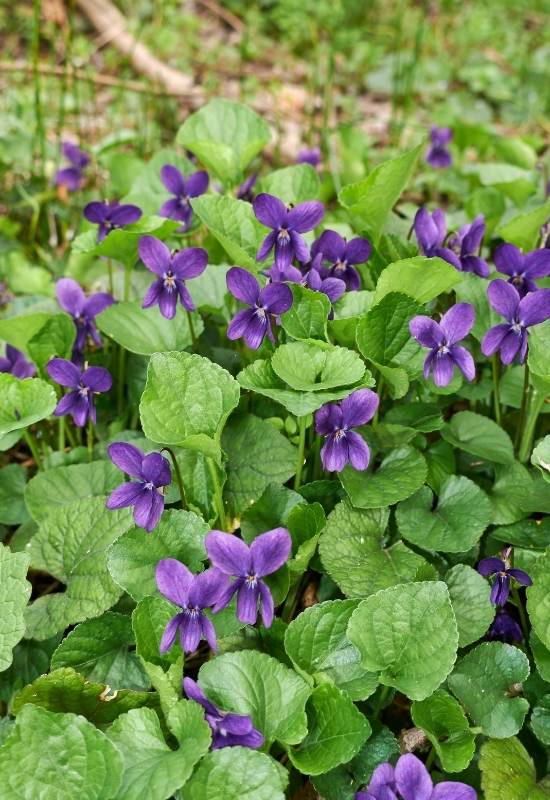
Many violets produce purple flowers, offering one of the most impressive color ranges, and they are all excellent as ground cover. However, ‘Queen Charlotte’ was selected for a few specific reasons. To start, its color is incredibly vibrant, strong, and intense, a perfect “purple 3” hue. The flowers feature elegant fading lines and veins toward the center, which showcases a golden eye that draws you in. Another reason is that this is a Viola odorata variety, which means it has fragrant blooms.
The heart-shaped leaves are a bright mid-green, similar to other varieties, and they will remain through the winter because the plant is evergreen.
‘Queen Charlotte’ sweet violet is an heirloom cultivar introduced in 1900. It offers an extra touch compared to other varieties. You can grow it to enjoy this amazing color when there is little else happening in your garden, as it even blooms in spring.
Hardiness: It thrives in USDA zones 4 to 8.
Light exposure: It does well in full sun or partial shade.
Blooming season: Flowers appear from winter to early spring.
Size: It grows 5 to 6 inches tall and spreads 1 to 2 feet wide.
Soil requirements: It needs fertile, regularly moist but well-drained soil, including loam, clay, chalk, or sand. A pH from mildly alkaline to mildly acidic is best.
8. ‘Darley Dale’ Winter Heath (Erica x darleyensis ‘Darley Dale’)
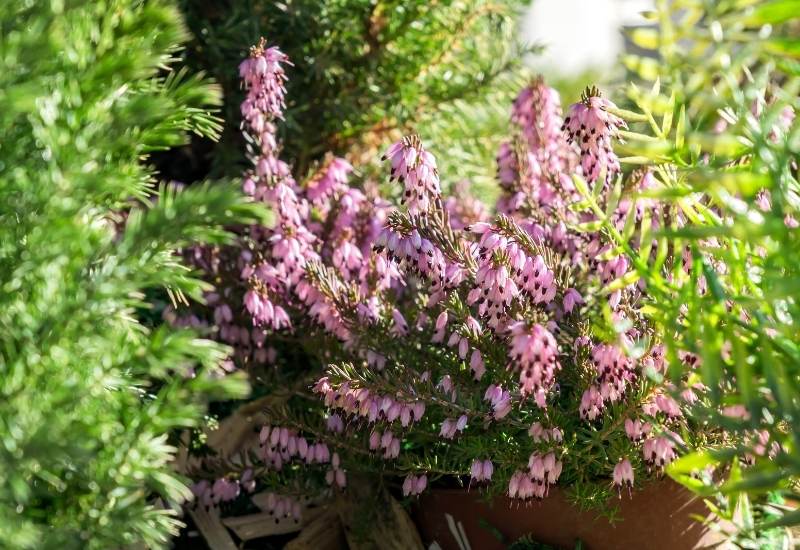
‘Darley Dale’ winter heath is one of the best heather varieties for ground cover if you want a sea of purple. While other varieties may have less distinct shades, this pick has a perfect, bright, and vivid deep mauve hue unlike any other.
Famous for its impressive winter blooms, this low shrub will be literally covered in a myriad of small flowers, even when it snows. Strong and low maintenance, it will keep weeds at bay and replace them with thick, decorative, needle-shaped leaves in the brightest mid to dark green shades.
‘Darley Dale’ winter heather is the perfect solution for difficult soils, such as acidic and moor-like conditions. If you still want a marvelous effect, it will turn your garden into a blooming spectacle from fall into spring.
Hardiness: It is hardy in USDA zones 6 to 8.
Light exposure: This plant requires full sun.
Blooming season: It blooms from fall to mid-spring, all through winter.
Size: It grows 1 to 2 inches tall and spreads 2 to 3 feet wide.
Soil requirements: It prefers sandy and well-drained loam, clay, or sand-based soil with a pH from acidic to neutral.
9. Chocolate Vine (Akebia quinata)

You can easily grow chocolate vine as a ground cover by simply letting it sprawl on the land instead of providing it with a climbing structure. While this might seem like a strange solution, it is quite common and offers many advantages. First, you can cover a wide area with just one plant. Second, you get mulberry-purple blooms with a very exotic look, on top of their rare color.
The fleshy blooms look like nodding open capsules and have a spicy cocoa fragrance. They are followed by edible, sausage-shaped violet pods that stand out clearly against the bright green ovate foliage. As the cold season approaches, even the foliage will turn purple. In warmer climates, it may stay on through the winter, as it is a semi-evergreen plant.
Chocolate vine has won the Award of Garden Merit from the Royal Horticultural Society and is ideal for large, shady areas, like under trees, where very few other plants can grow.
Hardiness: It is hardy in USDA zones 5 to 9.
Light exposure: It thrives in full sun, partial shade, and full shade.
Blooming season: It blooms in the spring.
Size: It reaches about 2 feet in height and can spread 15 feet or more.
Soil requirements: It needs well-drained but regularly moist soil, including loam, clay, chalk, or sand, ideally sandy loam, with a pH from mildly alkaline to mildly acidic.
10. ‘Sweet Heidy’ Cranesbill (Geranium ‘Sweet Heidy’)
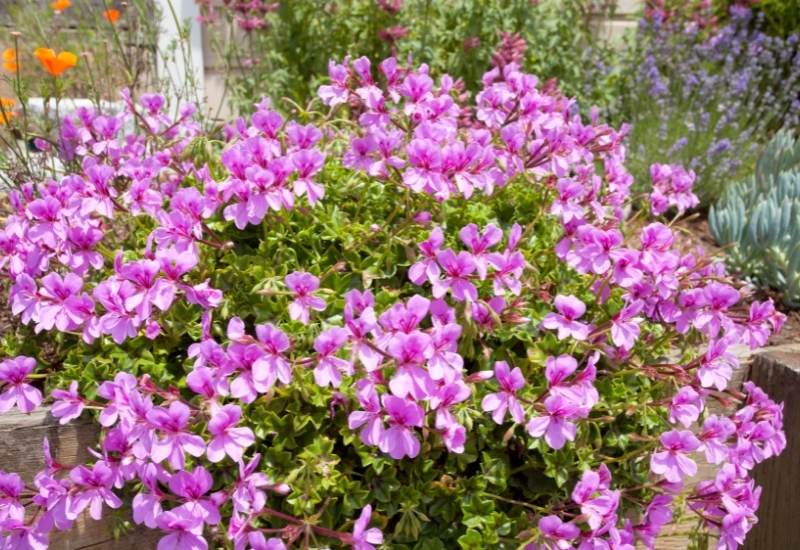
Cranesbills are perfect ground cover plants for all sunlight conditions, and ‘Sweet Heidy’ has some of the best purple flowers of this species. The blooms have a very vibrant shade of amethyst that fades as it approaches the center. You will also notice beautiful jam-colored veins that radiate from the middle like sun rays, with dark wine-purple pistils completing the effect.
This spreading perennial features finely textured and deeply cut foliage in a mid-green range. The foliage is thick and ideal for use as a ground cover.
‘Sweet Heidy’ cranesbill is perfect for planting under trees and shrubs to protect the soil and add a layer of interest in shady places. You can also grow it in other sunlight situations, as long as your garden has an informal style.
Hardiness: It is hardy in USDA zones 4 to 8.
Light exposure: It grows well in full sun, partial shade, and full shade.
Blooming season: You can expect blooms from early summer to late fall.
Size: It grows 1 to 2 feet tall and has a similar spread.
Soil requirements: It prefers well-drained loam, clay, chalk, or sand with a pH from mildly alkaline to mildly acidic and is drought tolerant.
11. Purple Rock Cress (Aubrieta deltoidea)

For a ground cover plant with very sweet-looking flowers, consider rock cress. The blooms have a perfect pure purple shade with a bright yellow dot at the very center. They have a very round and full shape, which gives them a gentle appearance. This generous little perennial will burst into amazing color for months on end, fully covering its foliage with blossoms.
The leaves are small, elliptical, and dense, with a bright mid-green shade. They may last through the winter season as long as it does not get too cold, because the plant is semi-evergreen.
Rock cress is perfect for planting between stepping stones, in crevices, and in rock gardens. It is better suited for small areas, but you could also try it for larger spaces or mix it with other ground cover plants.
Hardiness: It thrives in USDA zones 5 to 7.
Light exposure: It does well in full sun or partial shade.
Blooming season: Flowers appear from mid-spring to early summer.
Size: It grows 4 to 9 inches tall and spreads 1 to 2 feet wide.
Soil requirements: It needs well-drained loam, chalk, or sand-based soil with a pH from mildly alkaline to neutral. It is drought-tolerant once established.
12. Winter Blooming Bergenia (Bergenia crassifolia)

Also known as elephant’s ears, winter-blooming bergenia is a classic ground cover plant. While not all species have purple flowers, Bergenia crassifolia does. The flowers are bright lilac and appear in elegant branching inflorescences called “cymes” on top of long stems that hover above the foliage. Each cluster is made up of dozens of flowers.
The evergreen leaves are famous for their almost succulent fleshiness, bright green and glossy color, and large, round shape, reaching 8 inches in length. The foliage will form a thick and decorative carpet on the ground, keeping the soil moist and providing a habitat for many beneficial small animals.
Winter-blooming bergenia is better suited for gardens in cold climates, as it does not tolerate heat. On the other hand, it can grow well even in heavy shade. It is a good choice for medium-sized areas and is popular for planting under trees.
Hardiness: It is hardy in USDA zones 3 to 8.
Light exposure: It thrives in full sun, partial shade, and full shade.
Blooming season: It blooms from winter to mid-spring.
Size: It grows 1 to 2 feet tall and has a similar spread.
Soil requirements: It needs humus-rich, regularly humid, and well-drained soil, including loam, clay, chalk, or sand, with a pH from mildly alkaline to mildly acidic.
13. Woolly Thyme (Thymus pseudolanuginosus)

Woolly thyme is a low-growing shrub with pale mauve flowers that is mainly used as a ground cover. The blooms appear in summer and are fairly dense, though not as much as in other thyme varieties or in heather, but they still attract lots of butterflies.
However, there is more to this plant. It forms a very thick mesh of prostrate branches, which are purple in color and covered with amazing soft foliage. The mid-green leaves are packed together very tightly and have a dense fluff on them. This creates the effect of a natural carpet that you will have all year round because it is evergreen.
Woolly thyme is perfect if you want a soft-looking effect in your garden. As it is very small, it is also excellent for planting between stepping stones.
Hardiness: It is hardy in USDA zones 4 to 9.
Light exposure: This plant requires full sun.
Blooming season: It blooms in the summer.
Size: It grows 2 to 3 inches tall and spreads up to 1 foot wide.
Soil requirements: It prefers medium fertile, well-drained loam, chalk, or sand-based soil with a pH from mildly alkaline to neutral. It is tolerant of drought, rocky soil, and salt.
14. Magenta Rock Rose (Cistus x pulverulentus ‘Sunset’)
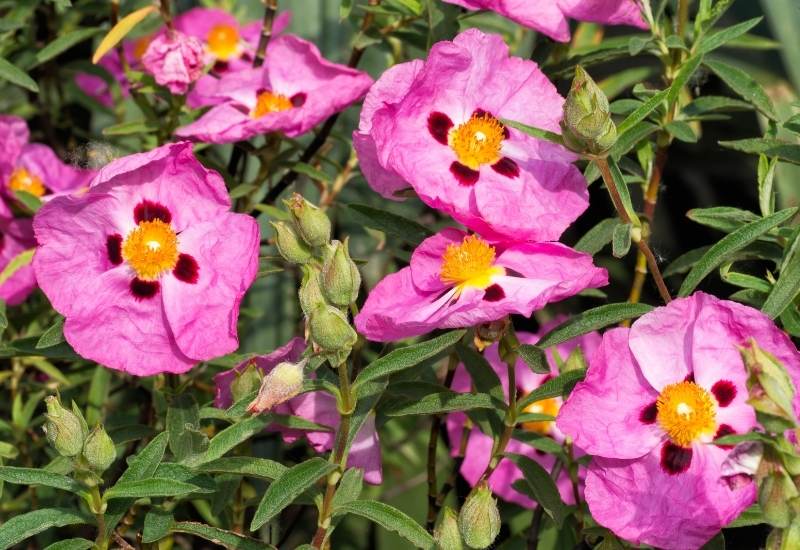
Magenta rock rose ‘Sunset’ is a prize-winning, low-shrub perennial ground cover for sunny gardens. The color of the blooms is very bright, full, and vibrant, with a golden center that enhances the luminosity of the flowers. Each flower head can reach 2 inches across, which is quite large for this type of plant.
It will keep blossoming for months on end. The leaves are pointed and veined, slightly fuzzy, and of a soothing shade of mid-green. This plant is also a winner of the Award of Garden Merit from the Royal Horticultural Society.
Equally suitable for ground cover or flower beds, magenta rock rose is the ideal choice if you want to bring lots of energy to your garden while covering and protecting your land.
Hardiness: It thrives in USDA zones 8 to 10.
Light exposure: This plant needs full sun.
Blooming season: It blooms from late spring to late summer.
Size: It grows 2 to 3 feet tall and spreads 6 to 8 feet wide.
Soil requirements: It requires well-drained loam, clay, chalk, or sand-based soil with a pH from mildly alkaline to mildly acidic. It is tolerant of drought and salt.
15. Persian Violet (Cyclamen coum)

Persian violet is the most typical cyclamen of temperate regions, and it is an exceptional ground cover. It can even grow under pine trees and other conifers. The flowers, with their reflexed petals, are typical of this famous plant, and in this variety, they are of a rosy purple shade. While it is not a large variety, it is also fairly cold-hardy.
The leaves are heart-shaped, glossy, dark green, and have lighter silver dots on them. They form lovely clumps under trees and shrubs and come back year after year because they naturalize easily if the soil is good. This plant is also a winner of the Award of Garden Merit from the Royal Horticultural Society.
Persian violet brings to mind woods and forests, and this is where it will look best in your garden. It will not tolerate full sun and is easier to grow in medium-sized areas, though in nature you can find large areas filled with these amazing flowers.
Hardiness: It is hardy in USDA zones 4 to 8.
Light exposure: This plant requires partial shade.
Blooming season: It blooms in winter and early spring.
Size: It grows 3 to 6 inches tall and spreads up to 8 inches wide.
Soil requirements: It needs rich and fertile, loose, and well-drained but regularly humid soil, including loam, chalk, clay, or sand, with a pH from mildly alkaline to mildly acidic.
Drape Your Garden in Purple with Ground Cover Plants
Purple ground cover plants can spread a green blanket over bare soil in a garden. Options are available for every light condition and climate.