Ready to take your garden to the next level? Tall perennials are the key to adding that show stopping vertical dimension to your borders and flower beds. These plants don’t just grow; they soar, drawing the eye upward and creating a lush, full landscape. With striking colors, unique foliage, and flowers bigger than life, they introduce a kind of harmony and drama that never fails to impress. This guide will walk you through the absolute best towering perennials to bring that “wow” factor to your garden year after year.
Why You Should Use Tall Perennials in Your Garden?
There are solid garden design principles behind using taller perennials, and they can completely transform your space.
First, they introduce a crucial layer to your planting scheme. This is especially important at the back of borders, creating a bridge between low growing flowers and taller trees. The result is a garden that feels wonderfully full and complete. Imagine a tall tree with just a few flowers at its base. Now, picture a striking perennial filling that middle space. The scene instantly looks more natural and thoughtfully designed.
These plants also bring leaves and flowers up to eye level, which is a vital element in garden design. We don’t spend all our time looking down at tiny blossoms or craning our necks to see the treetops. Most of our attention is right in the middle, and many gardens are missing this essential layer of beauty. Plus, you can strategically use tall perennials to screen unsightly views, like unattractive walls or garbage bins.
They also provide a wonderful habitat for small wildlife. Tall perennials create safe corridors for hedgehogs, frogs, and other creatures to hide and move about your garden. And remember, because perennials come back every year, they are the smart choice for the back of a border. You won’t have to trample your other plants every spring just to replant annuals in a hard to reach spot.
Some Tips to Grow Tall Perennials
These pointers, gathered from experience, will help you get the most out of your towering plants.
Always ensure your tall perennials remain accessible. It is easy to plant them far in the back and then forget about them, but even these hardy plants may require occasional pruning, deadheading, or watering. Make sure you can reach them without a struggle.
Consider the foliage density. If your goal is a solid “green wall” to create a visual stop, choose varieties with thick, dense leaves, such as Russian sage. However, if you prefer a more delicate, see through effect, opt for perennials with sparser foliage, like foxglove.
Pair them with smaller plants for a pleasing effect. A gradual increase in plant height often looks more natural than an abrupt wall of green, though the right choice depends on your garden’s style and the look you want to achieve. If you need a little extra lift, you can grow them in containers. Think of pots as high heels for your plants, giving them an instant boost.
15 Best Tall Flowering Perennials To Add Height in Your Garden
You can find giant perennials for every situation, from full sun to deep shade. Plants like hollyhock, foxtail lily, and sneezeweed thrive in bright sunlight, showing off their full beauty. To illuminate darker spots in the garden, select vividly colored perennials like foxglove or baneberry. These will command attention with their generous size when planted alongside lower growing companions.
The following list features tall perennials chosen not just for their height, but also for their personality, presence, and the quality of their flowers and foliage. Here are 15 extra tall perennials you need for adding color, blooms, and that essential vertical pull to your garden.
1. Foxglove (Digitalis spp.)
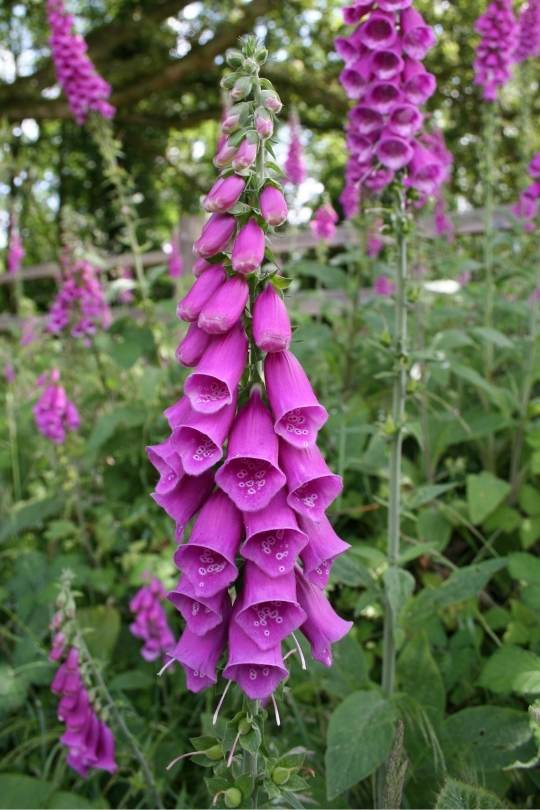
Foxglove is a timeless tall perennial, celebrated for its lovely bell shaped flowers arranged on long, upright spikes. It delivers a burst of color and vibrancy with blooms that can last an entire season. This plant adds a powerful vertical dimension, as its flower stems form tall cones of color pointing toward the sky.
Many varieties are available, from the shorter Digitalis obscura to the towering Digitalis purpurea. The genus includes numerous award winners, such as the magenta flowered Digitalis purpurea ‘Camelot rose’ and the lime yellow Digitalis grandiflora. It’s a perfect fit for borders and beds in informal settings, especially in English country gardens, and is an absolute must have for any cottage garden.
Hardiness: USDA zones 3 to 8.
Light exposure: full Sun or partial shade.
Blooming season: spring and summer.
Size: 2 to 6 feet tall (60 to 180 cm) depending on the variety and 1 to 3 feet wide (30 to 90 cm).
Soil requirements: adaptable to well drained loam, clay, chalk or sandy soil.
2. Valerian (Valeriana officinalis)
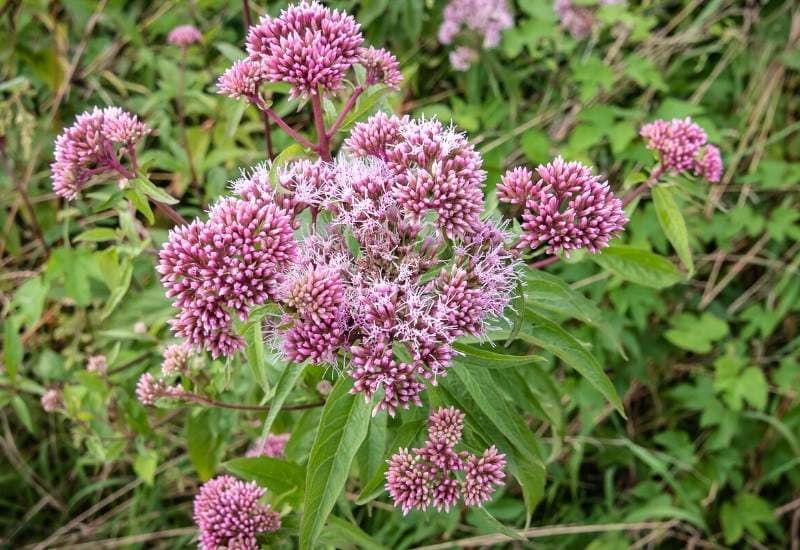
Valerian is not just a well known healthy herb; it’s also a tall perennial that can reach a height of 5 feet. This height, however, is only achieved when it’s in bloom. This makes it a wonderfully dynamic plant that can transition from a mid height to a tall presence, shifting the overall aesthetic of your border throughout the season.
The abundant blooms are pink and white, with a delicate, lace like appearance. Valerian is fantastic in informal gardens and wild prairies but isn’t the best choice for a solid hedge or visual barrier. Of course, with this plant, you get the double benefit of a useful herb to harvest and a beautiful, towering perennial flower.
Hardiness: USDA zones 4 to 8.
Light exposure: full Sun or partial shade.
Blooming season: summer.
Size: 5 feet tall (1.5 meters) and 3 feet in spread (90 cm).
Soil requirements: it prefers well drained, humus rich and loam based soil. It will also adapt to well drained and nutrient rich clay and sandy soil.
3. Monkshood (Aconitum spp.)
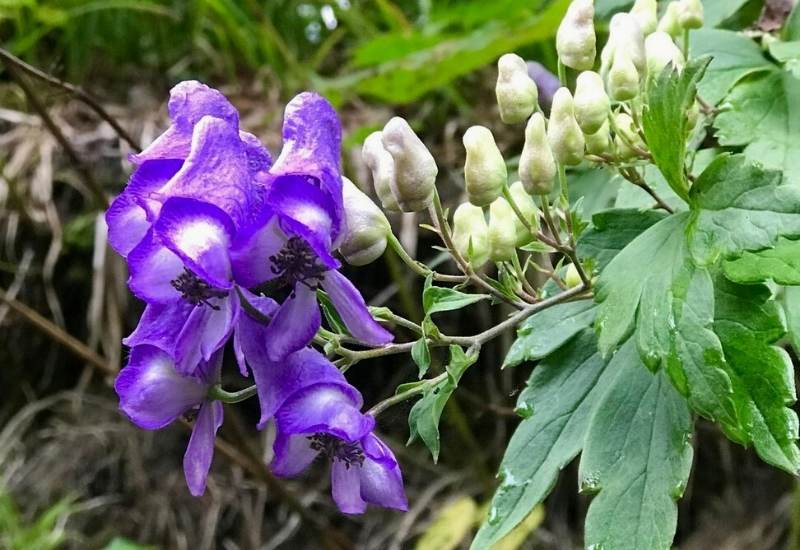
Monkshood, also known as aconite or devil’s helmet, is a stunning herbaceous tall perennial. Its flowers are incredibly striking, with a unique shape that resembles a monk’s hood. These original blooms appear on inflorescences with spaced out flowers, giving them a very light and airy appearance.
With about 250 different species, monkshood typically has low growing foliage but sends up very tall stems topped with colorful racemes. This characteristic makes them perfect for creating a “veil” effect in your garden rather than a solid “wall.” They shine in informal borders and beds, where the fluttering flowers seem to float in the air at eye level.
Hardiness: usually USDA 6 to 10. Many species will tolerate zone 3, 4 and 5 too like Aconitum napellus a common garden species (USDA zones 3 to 8)
Light exposure: full Sun or partial shade.
Blooming season: summer.
Size: up to 8 foot tall when in bloom (2.4 meters) and
Soil requirements: well drained and rich soil, with constant humidity, it prefers loam, but clay and sand are fine.
4. Elfdock (Inula helenium)
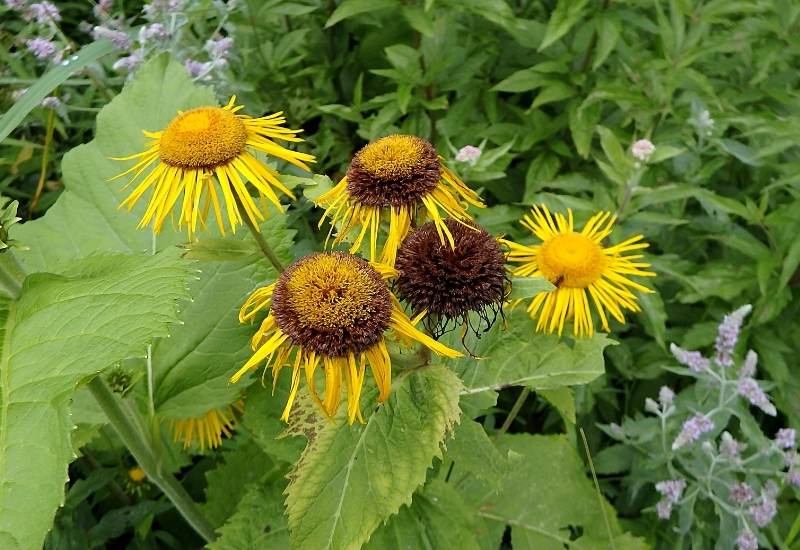
Elfdock is a tall perennial featuring bright yellow, showy flowers that look a bit like untidy sunflowers. As a relative of the aster, it has a vibrant yet rebellious character. Combined with its herbaceous and spontaneous look, elfdock is an ideal choice for achieving a natural and wild aesthetic in the garden.
The abundant flowers are perfect for the back of naturalistic borders. Its broad, heart shaped foliage is also highly decorative. This plant is especially well suited for wilder, low maintenance areas of a large garden. Often called a wildflower, it is quite easy to grow directly from seed.
Hardiness: USDA zones 5 to 8.
Light exposure: full Sun or partial shade.
Blooming season: summer to fall.
Size: 4 to 6 foot tall (1.2 to 1.8 meters) and up to 4 feet in spread (1.2 meters).
Soil requirements: adaptable to all well drained soil types with pH between 6.5 and 7.5.
5. Sneezeweed (Helenium autumnale)
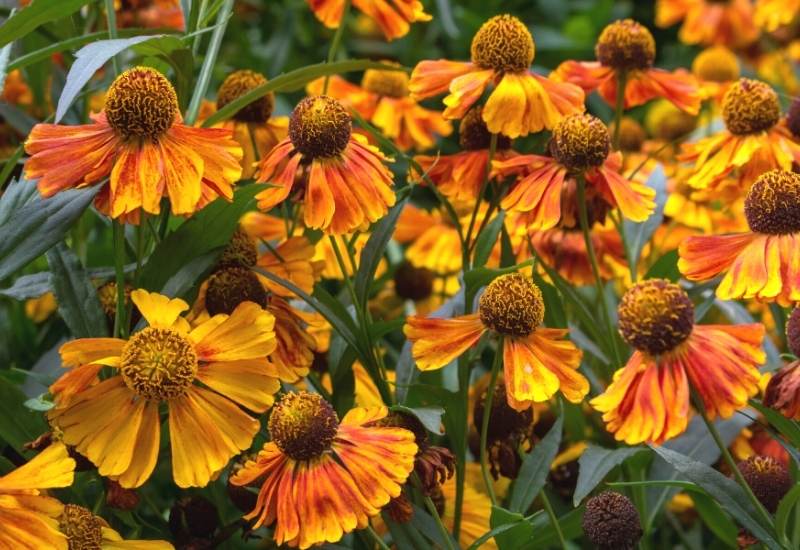
Sneezeweed is a tall, North American flowering perennial related to sunflowers. It shares their bright, energetic look, though its flower heads are smaller, around 3 inches across. These numerous flowers bloom in a range of lively colors, including yellow, orange, red, and purple.
This perennial is perfect for lifting a border that needs a dose of life, energy, and vibrancy. It also fits well in large wild prairies and cottage gardens. Sneezeweed looks best when planted in large clumps, which maximizes its bright, cheerful effect. It is generally better suited to informal garden settings than formal ones.
Hardiness: USDA zones 3 to 9.
Light exposure: full Sun.
Blooming season: fall.
Size: about 5 feet tall (1.5 meters) and 2 feet wide (60 cm).
Soil requirements: adaptable to well drained loam, clay, chalk or sandy soil with pH between 5.5 and 7.0.
6. Meadow Rue (Thalictrum spp.)
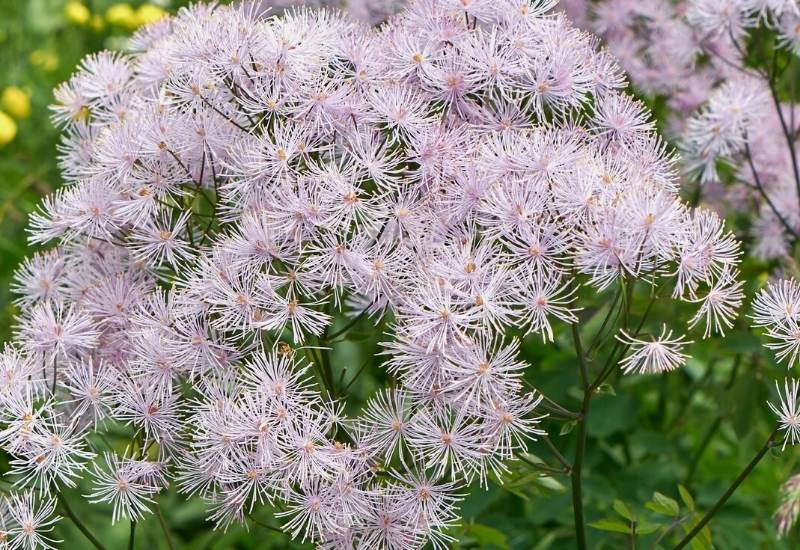
Meadow rue is a perennial flower that can tower up to 8 feet tall. It crowns this height with spherical, snowflake like flowers that appear in elegant inflorescences. The blooms come in a variety of delicate colors depending on the species, including lavender, cream, and light yellow.
This is a rather wild looking herbaceous perennial that works well as a screen or at the back of a bed or border. In these positions, its flowers can be appreciated as a collective whole rather than individually. The overall effect is what you want from this plant, making it a perfect choice for a delicate and airy backdrop.
Hardiness: USDA zones 3 to 9.
Light exposure: partial shade, but they can also grow in full Sun in temperate areas.
Size: up to 8 feet tall (2.4 meters), though most varieties will be between 4 and 6 fe tall (1.2 to 1.8 meters).
Soil requirements: it likes well drained and humid humus rich soil, and it adapts to loam, clay and sandy soil.
7. Desert Candles or Foxtail Lily (Eremurus spp.)
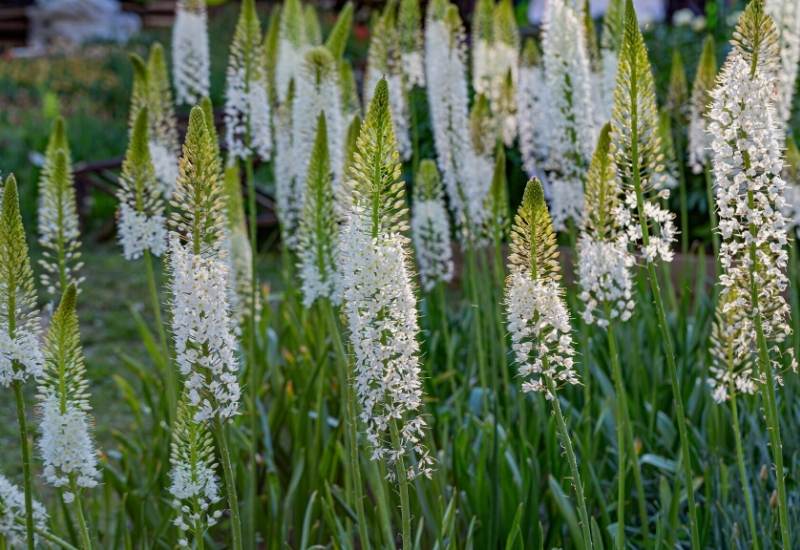
The name “desert candle” perfectly describes this perennial, which features tall, showy spikes packed with flowers. These spikes rise like fiery blades in a wide array of colors, from white to bright yellow, orange, pink, red, and purple. The blooms open from the bottom up, with many star shaped flowers lighting up the long stalk to the very top.
The foliage is also blade like and elegant, making this tall bulbous perennial a great choice even for a front garden. Its architectural form looks stunning in showy flower beds or borders. You could even plant it along your front path, where the blooms will line the way like candles guiding guests to your door.
Hardiness: USDA zones 5 to 8.
Light exposure: full Sun.
Blooming season: spring and summer
Size: up to 10 feet tall (4 meters) and up to 3 feet in spread (90 cm).
Soil requirements: it prefers sandy loam but it will adapt to well drained loam, clay or sandy soil. It is drought resistant.
8. Chimney Bellflower (Campanula pyramidalis)
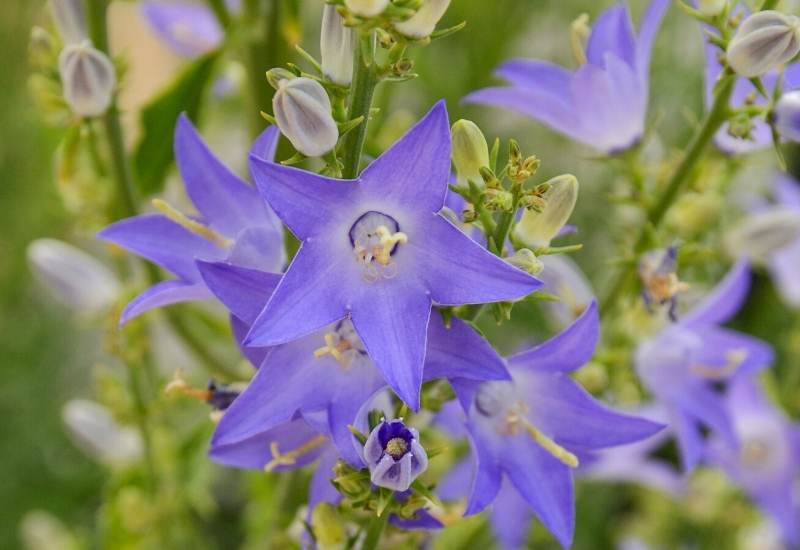
Meet the chimney bellflower, a magnificent herbaceous perennial with flower spikes that can climb to 5 feet. This is a classic looking bellflower, featuring lilac to lavender bell shaped blossoms that open like stars. As its Latin name suggests, the inflorescences are cone shaped and very long.
Chimney bellflower is another tall perennial that shines in wild and naturalistic garden styles, such as cottage and English country gardens. It is perfect for the middle or back of large borders or for expansive flower beds. However, it’s a short lived perennial, lasting only 2 to 5 years, so you’ll need to replace it or let it self seed. It has naturalized in many parts of southern Europe and will not bloom in its first year.
Hardiness: USDA zones 7 to 10.
Light exposure: full Sun.
Blooming season: summer.
Size: 5 to 7 feet tall (1.5 to 2.1 meters) and 2 feet in spread (60 cm).
Soil requirements: well drained soil of most types, loam, clay, chalk or sand.
9. Globe Thistle (Echinops bannatocus)
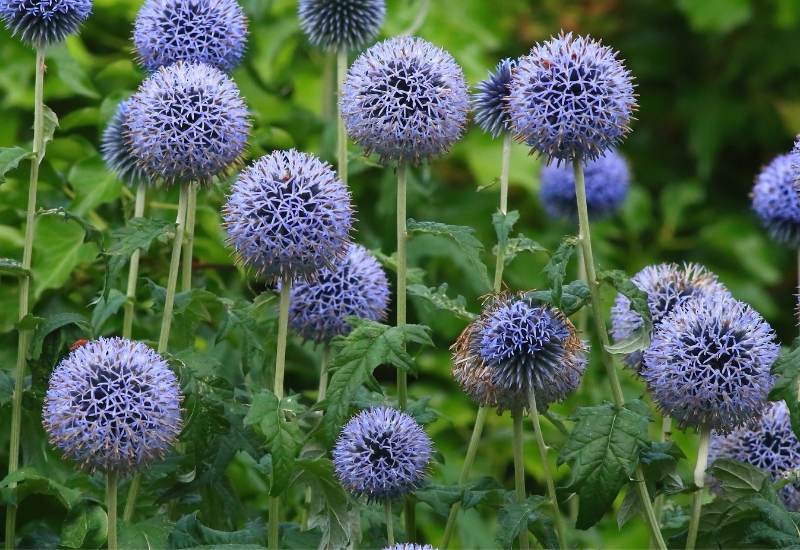
Echinops bannaticus is a type of globe thistle that grows taller than most, capable of reaching up to 6 feet. At that impressive height, you’ll be treated to its beautiful, perfectly spherical inflorescences. Each flower head is about 1.5 inches in diameter and boasts a bright, showy lavender purple color.
Plant this perennial in clumps within your beds to maximize its beautiful overall effect. While its unique flowers could fit into a formal garden, it’s generally better suited for informal settings. The foliage also looks fantastic in a xeric, dry, or rocky garden environment.
Hardiness: USDA zones 3 to 8.
Light exposure: full Sun or partial shade.
Blooming season: summer.
Size: 4 to 6 feet tall (1.2 to 1.8 meters) and 2 to 3 feet in spread (60 to 90 cm).
Soil requirements: well drained loam, chalk or sandy soil. It is drought resistant and rocky soil tolerant.
10. Hillside Black Beauty (Actaea simplex)
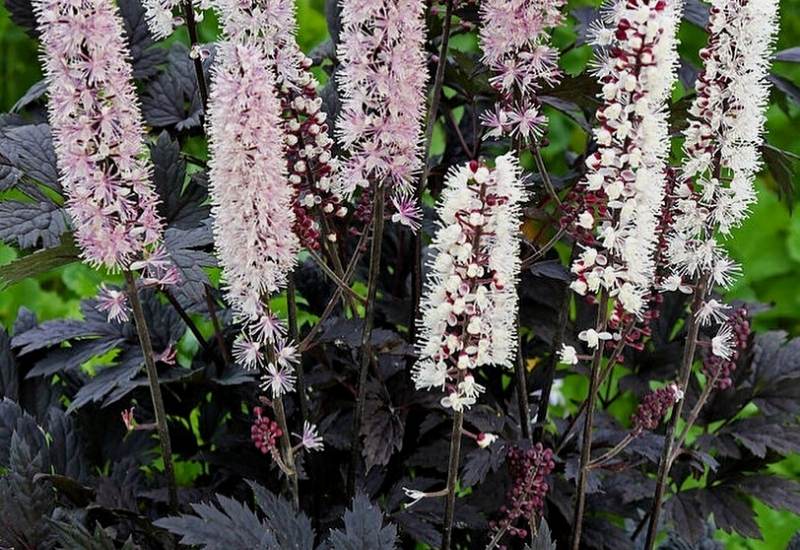
Hillside Black Beauty is a highly decorative and architectural perennial. It features striking foliage, with broad, segmented leaves in a stunning dark purple shade. This foliage forms a rich, elegant shrub that stays relatively low to the ground. Rising high above it are the blooms, which can reach up to 6 feet. They appear as spikes of white to pink flowers on deep purple stems.
This plant is an excellent choice for adding foliage color to beds and borders. It adapts well to formal settings but also looks at home in informal gardens. You can even grow it in beautiful containers to give it some extra elevation and presence.
Hardiness: USDA zones 3 to 7.
Light exposure: partial shade, avoid afternoon Sun.
Blooming season: late summer.
Size: up to 6 feet tall (1.8 meters) and 3 feet in spread (90 cm).
Soil requirements: well drained and moist loam or clay.
11. Plume Poppy (Macleaya cordata)
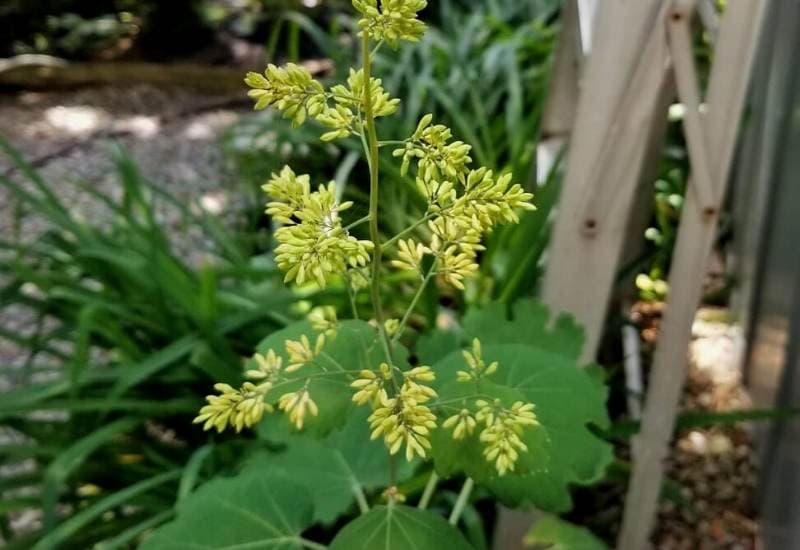
Plume poppy is a wonderful garden perennial that brings texture, color, and height to your beds and borders. Though it is related to poppies, you wouldn’t guess it from the flowers. They look like colorful fluff on long, thin, branched stems, which is why it is called “plumed.” The blooms can be white, yellow, pink, orange, red, or purple. They rise above broad, highly decorative foliage that can be green or even blue.
It’s a lovely choice for filling in borders and is adaptable to many conditions. Plume poppy looks particularly great in dappled shade, where its impressively decorative leaves contribute to a very lush appearance.
Hardiness: USDA zones 3 to 8.
Light exposure: full Sun or partial shade. Keep in partial shade in hot countries.
Blooming season: summer.
Size: 6 to 8 feet tall (1.8 to 2.4 meters) and 3 to 4 feet in spread (90 to 120 cm).
Soil requirements: it adapts to most soil types, as long as well drained: loam, clay, chalk or sand are fine.
12. Hollyhock (Alcea rosea)
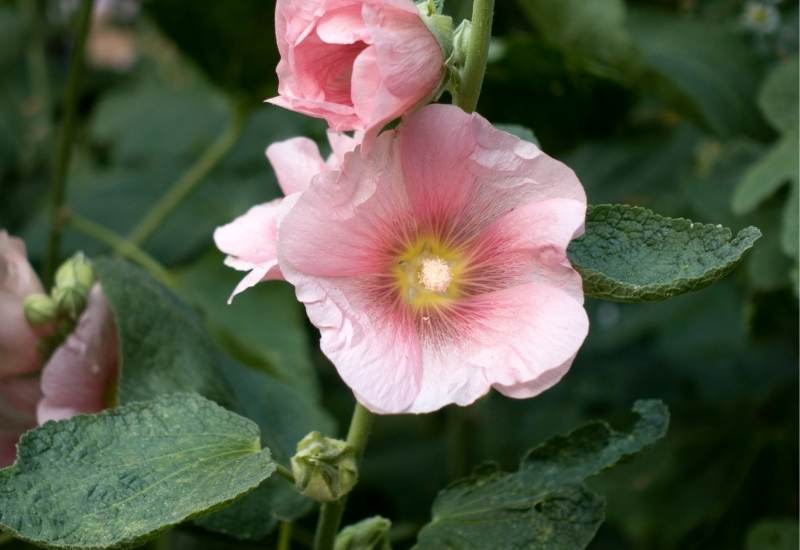
Hollyhock is a classic tall herbaceous perennial and an all time favorite in the garden. Offering flowers in nearly every color, from white to purple and all the pinks, reds, oranges, and yellows in between, it is incredibly easy to grow and blooms for months on end. The showy flowers appear on very long stems, making it a distinctly vertical plant that is perfect for adding an upright dimension to your borders and beds.
While hollyhocks are showy, their herbaceous nature makes them most suitable for natural looking gardens, tall beds, and informal borders. They are commonly used to embellish walls and line paths and ditches.
Hardiness: USDA zones 3 to 9.
Light exposure: full Sun.
Blooming season: summer.
Size: 5 to 6 feet tall (1.5 to 1.8 meters) and 1 to 2 feet wide (30 to 60 cm).
Soil requirements: adaptable to well drained loam, clay, chalk or sand based soil.
13. Big Bluestem (Andropogon Gerardii)
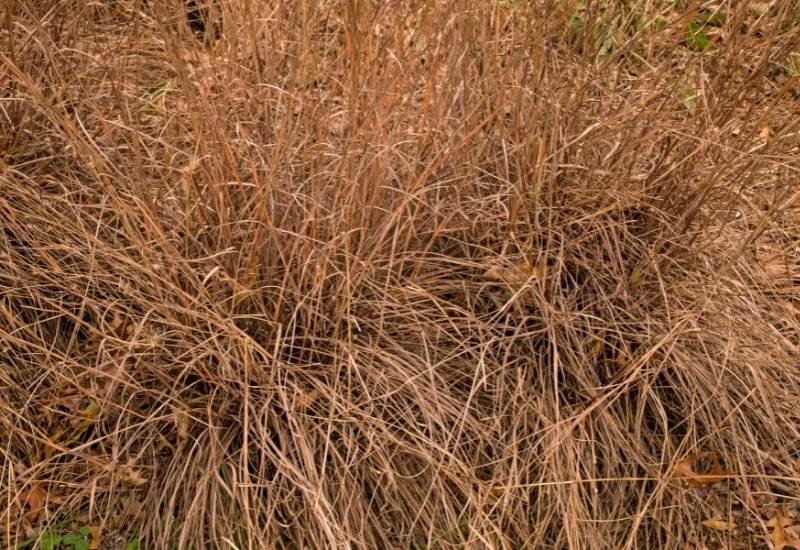
Big bluestem is a tall and beautiful perennial grass that comes in several varieties. Some are green, while others lean more toward red, like the ‘Indian Warrior’ cultivar. While it won’t give you showy flowers, it has an undeniable presence. Its upright habit features very long stalks that end in small, ear like plumes.
This grass is beautiful all year round. Consider it for creating clumps where foliage is the main attraction or for giving a vertical push to your borders and beds. Big bluestem looks great even in a lawn and is a perfect choice for gravel gardens and low maintenance urban landscapes.
Hardiness: USDA zones 3 to 9.
Light exposure: full Sun.
Blooming season: N/A.
Size: 5 to 6 feet tall (1.5 to 1.8 meters) and 1 to 2 feet in spread (30 to 60 cm).
Soil requirements: well drained loam, clay, foam or sandy soil. Drought resistant.
14. Torch Aloe (Aloe arborescens)
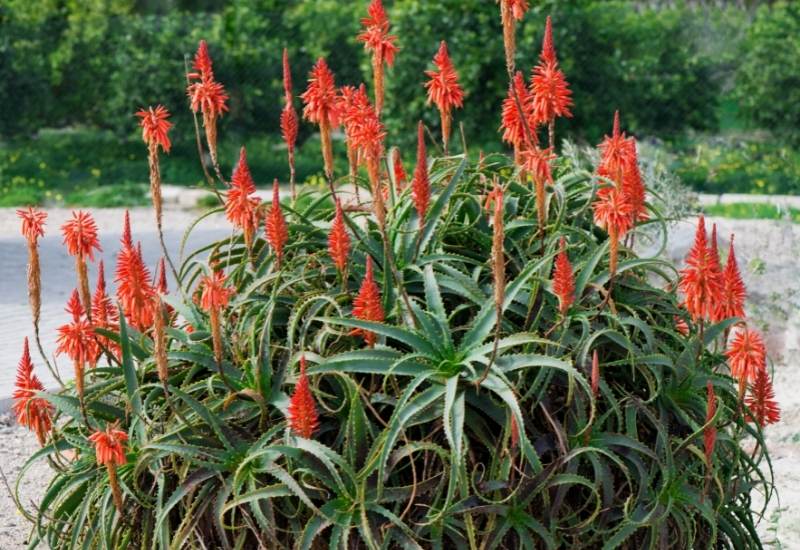
For gardens in warmer climates, torch aloe is a perfect tall flowering perennial. This wonderful succulent is a close relative of the more famous aloe vera, but it is much larger, growing up to 10 feet tall. It produces massive, long lasting blooms of flaming red, tubular flowers. These waxy blossoms appear in spikes that resemble burning candelabra, giving the plant its name.
This is a fantastic plant for large flower beds. Alternatively, you can grow it as a standalone specimen to fully appreciate its dramatic form. It is ideal for many garden styles, including formal, informal, desert, and gravel gardens, though it might look out of place in a cottage garden.
Hardiness: USDA zones 9 to 11.
Light exposure: full Sun.
Blooming season: winter to spring.
Size: up to 10 feet tall and in spread (3 meters).
Soil requirements: well drained loam or sandy loam. It is drought resistant and salt tolerant.
15. Culver’s Root (Veronicastrum virginicum)
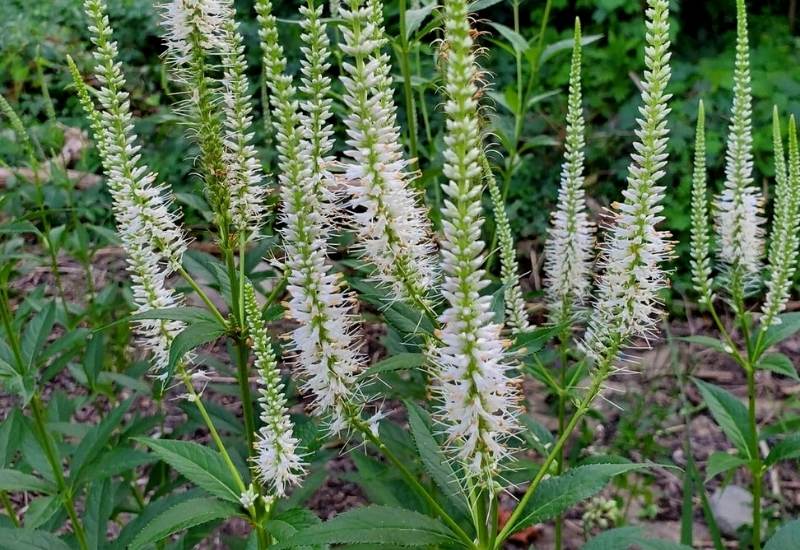
Culver’s root is a lesser known but highly rewarding tall perennial. It forms clumps of long stems adorned with whorls of leaves that look like “stars” arranged at regular intervals, similar to a pagoda roof. At the top, it produces long, thin spikes of many tiny flowers, some of the most elegant you can find. They can be white, pink, or lavender.
The blooms last for a very long time and appear late in the season. This makes Culver’s root the perfect tall perennial for bringing life and light to borders when it’s often difficult to keep them looking fresh. It is an ideal choice for informal garden settings.
Hardiness: USDA zones 3 to 9.
Light exposure: full Sun.
Blooming season: mid summer to fall (included).
Size: 4 to 6 feet tall (1.2 to 1.8 meters) and 2 to 3 feet in spread (60 to 90 cm).
Soil requirements: well drained loam or clay based soil. It is heavy clay tolerant as well as wet soil tolerant.
Going Up to the Sky with Tall Perennials
You have to agree that there are some truly beautiful tall perennials available for your garden. While some are simply tall, many have an upward pointing growth habit that draws the eye toward the sky. These plants have an uplifting effect on any garden space. Be sure to include some in your own design; they have a way of bringing a little piece of the sky right into your backyard.