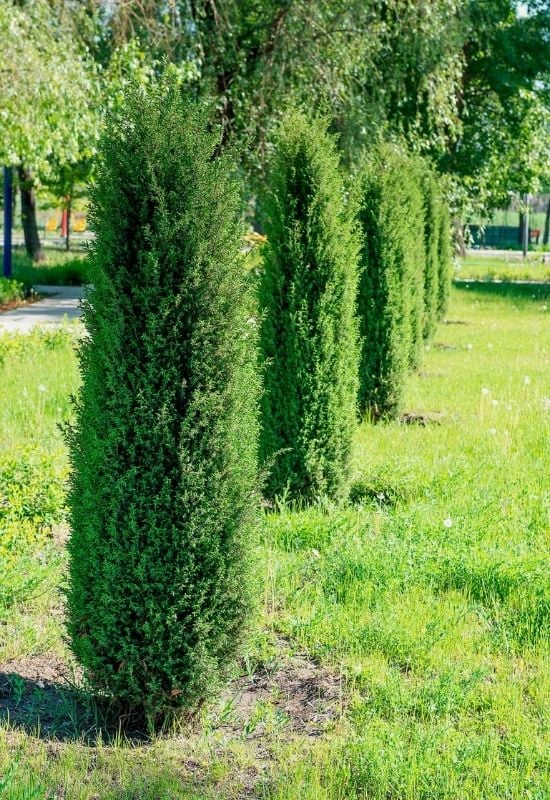
Imagine your property line. You could have a tall brick wall or a stark wooden fence. Or, you could have a living screen of tall, narrow shrubs, bursting with foliage, texture, and even flowers. Both options offer privacy from prying eyes, but only one transforms your space into a green sanctuary that changes with the seasons.
Shrubs with an upright, fastigiate shape are perfect for creating stunning decorative highlights. You can plant them between your home and driveway, along a fence, or in a neat row to act as a punctuation point in your landscape design.
Whether they’re evergreen or deciduous, shrubs with a columnar, conical, or pyramidal form can create a fantastic privacy screen. When planted in groups, they form a narrow hedge that works beautifully even when space is limited. There’s a surprisingly wide variety of slender shrubs that need very little pruning to keep their shape, making them ideal for screening in smaller urban or suburban gardens.
If you’re looking to block an unwanted view, draw the eye to a garden feature, or simply plant a decorative privacy hedge, here are 15 excellent tall and narrow shrubs perfect for tight spaces.
1. ‘Compressa’ Common Juniper (Juniperus communis ‘Compressa’)
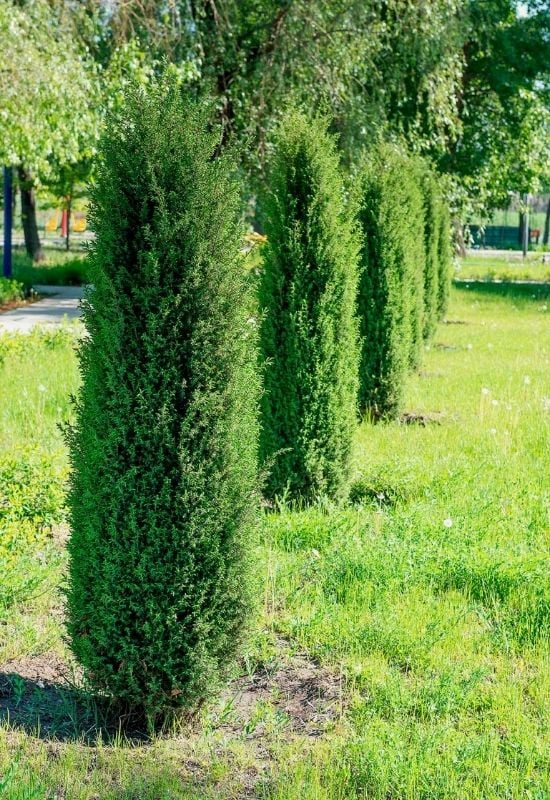
For a compact, columnar, and incredibly dense screening shrub, the ‘Compressa’ common juniper is a truly exceptional pick.
Its aquamarine, blue-green foliage consists of tightly packed needles that bring a unique accent to any garden. During winter, it takes on beautiful copper-bronze tones. This evergreen conifer is both incredibly low maintenance and exceptionally tough. It’s cold hardy and drought resistant, making it perfect for urban and suburban gardens where you might not have much time for yard work. While not exceedingly tall, it’s small enough to thrive in containers, allowing you to easily raise it to eye level for screening.
The ‘Compressa’ common juniper introduces unusual colors to your garden and can also be used as a specimen plant to add a vertical dimension to your design. Plus, you’ll be able to boast that you have a winner of the prestigious Award of Garden Merit from the Royal Horticultural Society in your collection.
Hardiness: USDA zones 2 to 6.
Light exposure: Full Sun.
Blooming season: N/A.
Size: 3 to 6 feet tall (90 cm to 1.8 meters) and 2 to 3 feet in spread (60 to 90 cm). It also grows well in containers.
Soil requirements: Medium fertile, well drained loam, clay, chalk, or sand with pH from mildly alkaline to mildly acidic. It is tolerant of drought and rocky soil.
2. ‘Sky Pencil’ Japanese Holly (Ilex crenata ‘Sky Pencil’)
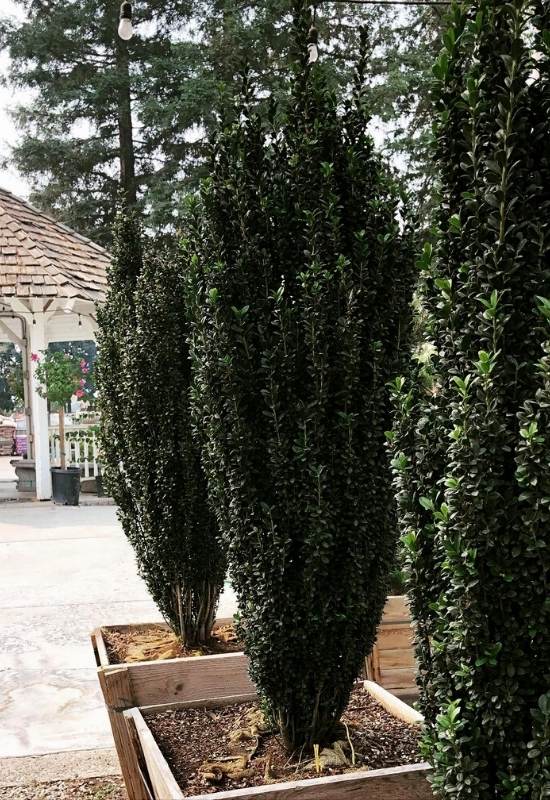
Growing up to 10 feet tall but only spreading to a maximum of 3 feet, the ‘Sky Pencil’ Japanese holly is as columnar as a shrub can get. It’s perfectly named.
The evergreen foliage is a deep, dark green and convex, which creates interesting plays of light. It grows on upright branches that run parallel to each other, looking as if they’re reaching for the sky. In spring, it produces small white flowers that give way to black fruits later in the season, though you’ll need both male and female plants for fruiting to occur. If you wish, you can even train it to grow into a small tree.
The ‘Sky Pencil’ Japanese holly is one of the most vertical shrubs you can find. While not as dense as some other options, it still provides enough coverage to screen your private spaces from passersby and curious neighbors.
Hardiness: USDA zones 6 to 8.
Light exposure: Full Sun or partial shade.
Blooming season: Spring.
Size: 6 to 10 feet tall (1.8 to 3.0 meters) and 1 to 3 feet in spread (30 to 90 cm).
Soil requirements: Medium fertile and well drained loam, clay, chalk, or sand with a pH from mildly alkaline to mildly acidic. It is drought tolerant.
3. ‘Green Spire’ Japanese Euonymus (Euonymus japonicus ‘Green Spire’)
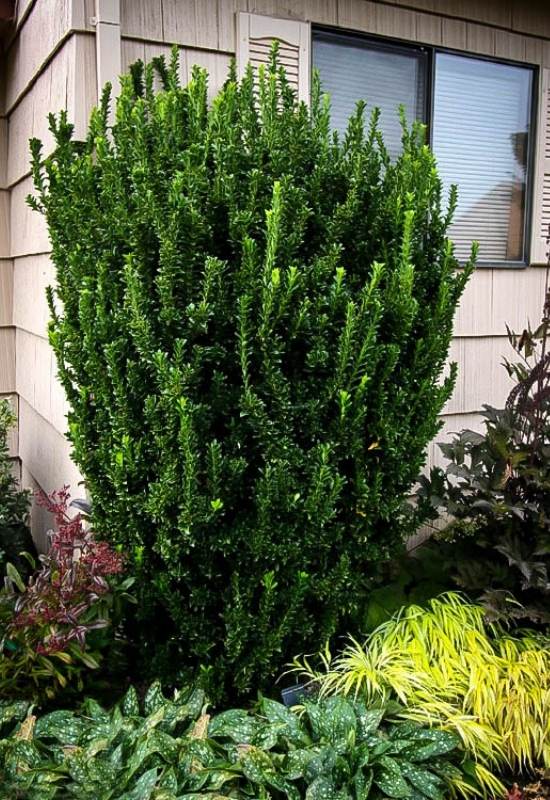
The ‘Green Spire’ Japanese euonymus is a fast-growing and fully screening shrub that can reach up to 8 feet in height while staying within a slim 2-foot spread.
Within this narrow space, you get beautiful, glossy, dark green evergreen foliage. Each leaf is shaped like a small spoon, concave and gently serrated at the edges. They grow on upward-reaching branches, forming a thick canopy that completely blocks the view. This quality makes it ideal for urban and suburban hedges, not only for its columnar shape and dense foliage but also because it’s a very reliable and low maintenance plant.
‘Green Spire’ Japanese euonymus fits well into many garden styles, including Asian, Mediterranean, urban, and gravel designs. It works in any informal setting, but if you’re willing to prune it regularly, it adapts beautifully to formal landscapes, a rare quality for a shrub.
Hardiness: USDA zones 6 to 9.
Light exposure: Full sun or partial shade.
Blooming season: Spring, but flowers are inconspicuous.
Size: 6 to 8 feet tall (1.8 to 2.4 meters) and 1 to 2 feet in spread (30 to 60 cm).
Soil requirements: Average, regularly moist but well drained loam, clay, chalk, or sand with a pH from mildly alkaline to mildly acidic. It can tolerate poor soil and thrives in urban environments.
4. ‘Orange Rocket’ Barberry (Berberis thunbergii ‘Orange Rocket’)
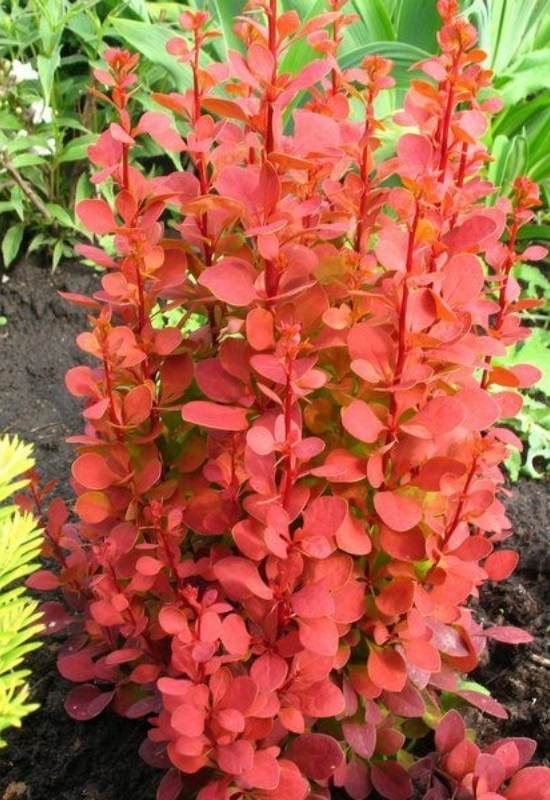
Compact and upright, the ‘Orange Rocket’ barberry is an explosion of warmth and color. Its coral to orange-red foliage can easily become a focal point in any small garden.
The round, deciduous leaves grow on vertical branches, forming a dense barrier to protect your privacy. The colors deepen in the fall, shifting to rich russet tints. In the spring, small, pale yellow, scented flowers appear, which later transform into crimson red berries that attract birds to your garden. Come winter, you are left with red, spiny stems. While they don’t completely block the view, they certainly deter intruders and remain dense and attractive.
The stunning foliage color is undoubtedly the main asset of the ‘Orange Rocket’ barberry as a screening shrub. You can bring vibrant energy to your small garden with this low maintenance and powerfully flaming plant.
Hardiness: USDA zones 4 to 8.
Light exposure: Full Sun or partial shade.
Blooming season: Spring.
Size: Up to 5 feet tall (1.5 meters) and 2 to 3 feet in spread (60 to 90 cm); it is also suitable for containers.
Soil requirements: Medium fertile, well drained loam, clay, chalk, or sand with a pH from mildly alkaline to mildly acidic. It is tolerant of drought and heavy clay.
5. ‘Fine Line’ Buckthorn (Rhamnus frangula ‘Fine Line’)
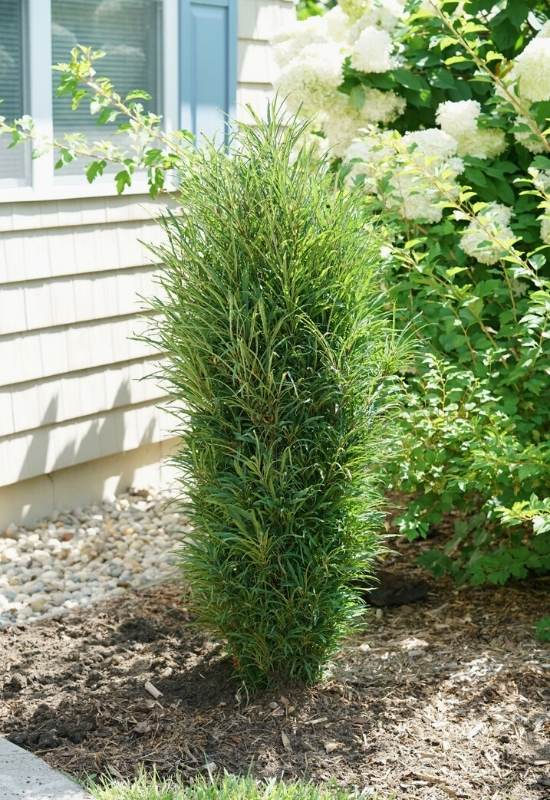
The fast-growing ‘Fine Line’ buckthorn is perfect for containers, blocking views from windows, or creating privacy as foundation planting. Its foliage is feathery and very elegant, with long, thin, mid-green leaves on upright branches that offer refined texture and a dense screen from spring through late fall. It’s also exceptionally hardy, making it a great choice for cold regions, including most of Canada.
‘Fine Line’ buckthorn has a discreet and elegant presence. It is gentle rather than showy, which allows it to work well in many situations. You can plant it with other shrubs, grow it in pots, feature it for its foliage in tall borders, or mix it into hedges, as long as the design is informal.
Hardiness: USDA zones 2 to 7.
Light exposure: Full Sun or partial shade.
Blooming season: Spring, but flowers are inconspicuous and green.
Size: 5 to 7 feet tall (1.5 to 2.1 meters) and 2 to 3 feet in spread (60 to 90 cm).
Soil requirements: Medium fertile, well drained but regularly moist loam, clay, or sand-based soil with a pH from mildly alkaline to mildly acidic. It tolerates brief periods of drought.
6. ‘Delta Moonlight’ Crape Myrtle (Lagerstroemia indica ‘Delta Moonlight’)
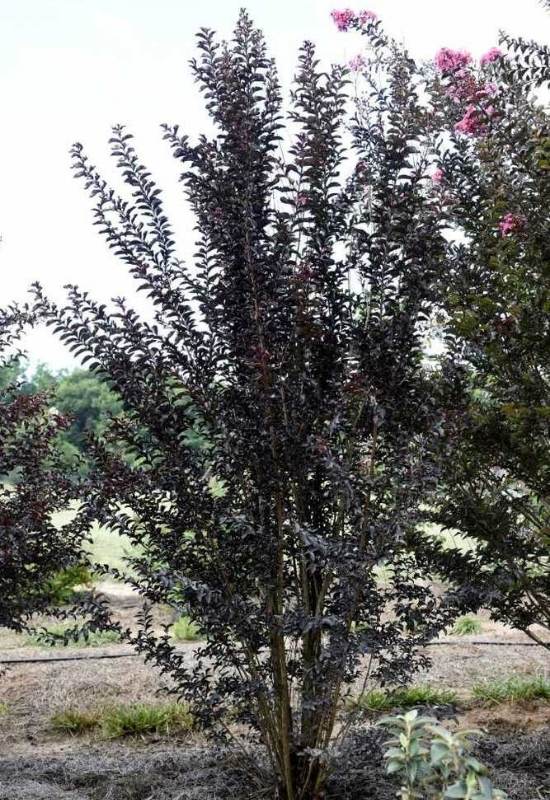
For gardens with a bit more room, the stunning ‘Delta Moonlight’ crape myrtle offers a truly decorative way to ensure privacy. Growing quickly to 12 feet, it will keep unwanted eyes off your property with a wall of uniquely colored foliage.
The thick leaves are the darkest shade of burgundy imaginable, almost appearing black. These curved and pointed leaves form a dense canopy from spring until the first frost. Late in the season, they host large clusters of flowers. The blooms are frilled and white with a gentle purple blush, hanging from pink petioles and packed tightly at the branch tips. This contrast is striking and eye catching, creating a real showstopper, perhaps at the back of your green space.
‘Delta Moonlight’ crape myrtle is excellent for screens, hedges, and windscreens, as well as for foundation planting. If you want to make a bold statement, this shrub might be the one for you.
Hardiness: USDA zones 7 to 10.
Light exposure: Full Sun or partial shade.
Blooming season: Summer and fall.
Size: Up to 12 feet tall (3.6 meters) and between 4 and 6 feet in spread (1.2 to 1.8 meters).
Soil requirements: Medium fertile and well drained loam, chalk, or sand with a pH from mildly alkaline to mildly acidic. It tolerates heavy clay and drought.
7. ‘Purple Pillar’ Rose of Sharon (Hibiscus syriacus ‘Purple Pillar’)
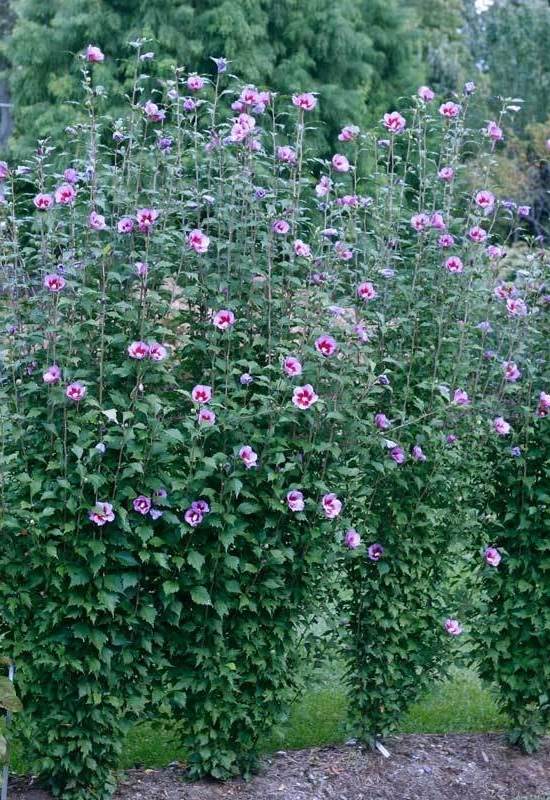
If you’re looking for a screening shrub with showy blooms, consider the ‘Purple Pillar’ rose of Sharon. This is an unusual cultivar that grows very tall while maintaining a narrow habit.
It can reach up to 16 feet in height but will only take up about 3 feet of horizontal space. Packed into this tiny area, you’ll get an abundance of beautiful, large, bright pink-purple flowers with a dark, rayed, wine-red center. The foliage is the classic serrated, mid to dark green type with an interesting texture. It grows on upright branches, forming a thick, lush pillar of dense leaves. You can also train it into a tree, but it is far more common to see it planted in rows to form green walls that block views from the ground up.
‘Purple Pillar’ rose of Sharon is ideal for adding exotic-looking blooms to gardens in fairly cold regions. It can also block views from higher vantage points, like the windows of nearby homes.
Hardiness: USDA zones 5 to 9.
Light exposure: Full Sun or partial shade.
Blooming season: Summer and fall.
Size: 10 to 16 feet tall (3.0 to 4.8 meters) and 2 to 3 feet in spread (60 to 90 cm).
Soil requirements: Medium fertile and well drained loam, clay, chalk, or sand with a pH from mildly alkaline to mildly acidic. It is tolerant of heavy clay and salt.
8. Blue Bamboo (Bambusa chungii ‘Barbelletta’)
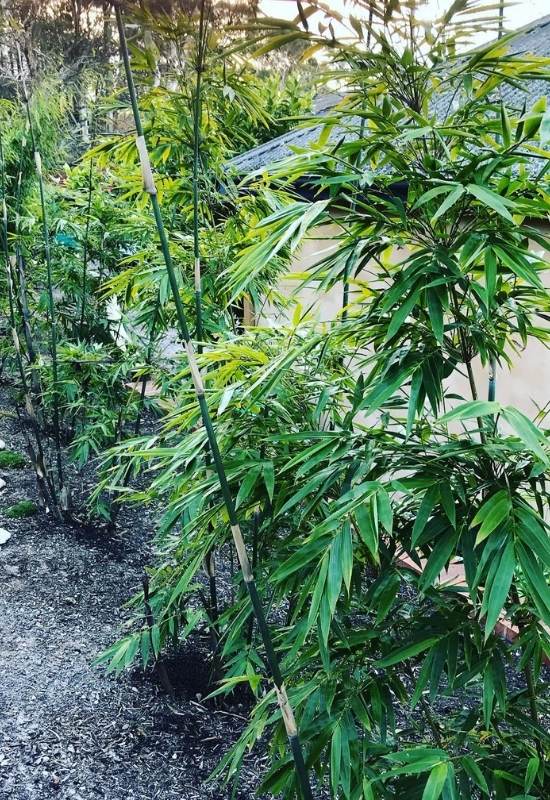
Blue bamboo grows incredibly tall, reaching up to 25 feet, and you can easily manage the width of its clumps to create shrubs of the perfect size for your privacy needs and available space.
This variety also adds a fascinating feature to your garden: the stems start green but mature to a striking blue-violet-silver color, complete with a frosted, icing-like effect. They grow in thick clusters, forming a genuine barrier for onlookers, and the bright green foliage at the top completes the beautiful effect. It’s a fast grower and relatively low maintenance; your main tasks will be watering and managing new shoots.
Although not technically a shrub, blue bamboo provides the same screening effect with an added oriental touch. It also offers the flexibility to be “cut to size” to fit your specific space and garden shape.
Hardiness: USDA zones 9 to 11.
Light exposure: Full Sun or partial shade.
Blooming season: N/A.
Size: 20 to 25 feet tall (6.0 to 7.5 meters) and each stem has a spread of 18 inches (45 cm), though clumps can reach 5 to 10 feet wide (1.5 to 3.0 meters).
Soil requirements: Fertile, well drained but consistently moist loam with a pH from mildly alkaline to mildly acidic.
9. ‘Golden Oakland’ Holly (Ilex hybrid ‘Magden’ PP30451)
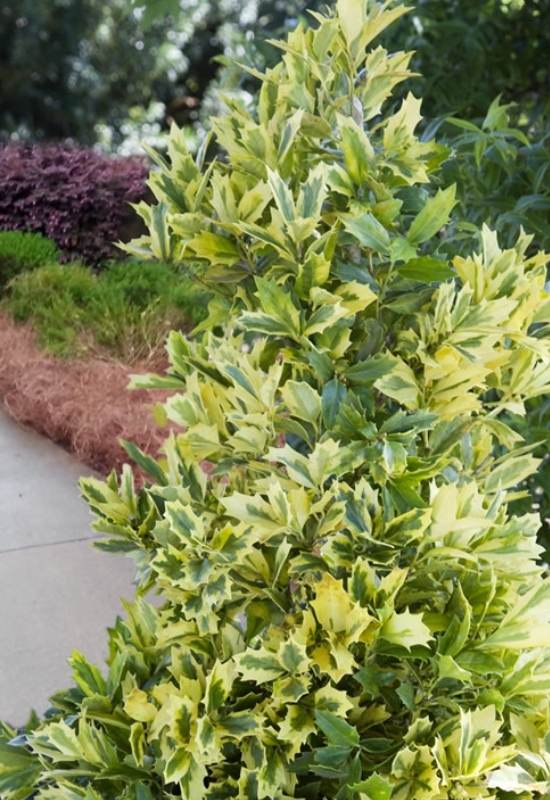
The ‘Golden Oakland’ holly is an evergreen shrub with a pyramidal shape, featuring a pointed tip and dense, screening foliage.
Its leaves are variegated with cream to golden-yellow and green, providing a wonderful, colorful display. They are also characteristically spiked and quite glossy. This variety offers year-round interest while being low maintenance and vigorous. It is ideal for foundation planting but also works well in hedges and screens in various garden styles, both formal and informal.
‘Golden Oakland’ holly can spread a bit, but like all plants in this genus, it tolerates pruning very well. This adaptability allows you to shape it as you wish, making it suitable for formal gardens. However, the best way to use this evergreen shrub is to preserve its natural pyramidal shape, perhaps just keeping it narrow if needed.
Hardiness: USDA zones 6 to 9.
Light exposure: Full Sun or partial shade.
Blooming season: N/A.
Size: 15 to 20 feet tall (4.5 to 6.0 meters) and 12 to 15 feet in spread (3.6 to 4.5 meters), but it can be contained with pruning.
Soil requirements: Medium fertile, well drained yet regularly moist loam, clay, chalk, or sand with a pH from mildly alkaline to mildly acidic.
10. ‘Golden Cone’ Common Juniper (Juniperus communis ‘Golden Cone’)
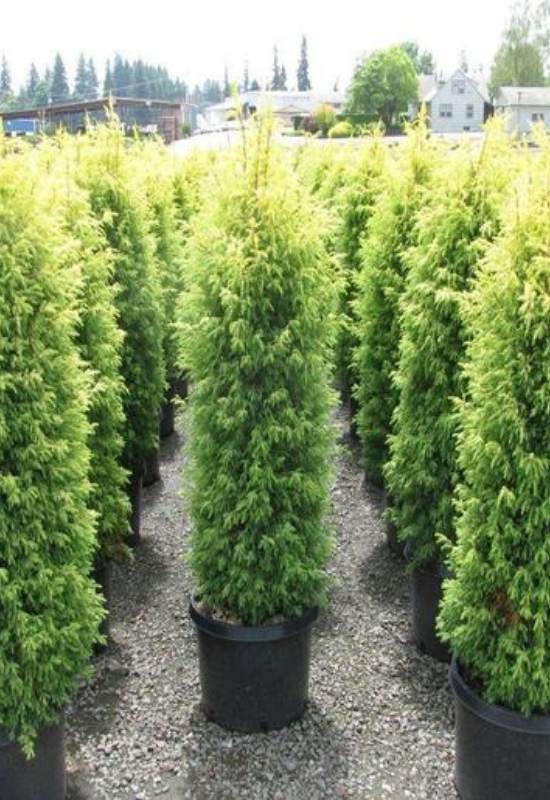
Just as its name suggests, the ‘Golden Cone’ common juniper is a tall, narrow, cone-shaped evergreen conifer. It works wonderfully for screening a small garden or adding interesting structure.
It also brings fantastic color, as its foliage is bright golden in the spring. As the season progresses, it retains its brightness while slowly transitioning to a more greenish tint. The texture is noteworthy too; the soft needles form a dense, delicate, cushion-like mass. To give it extra height, you can plant it in a container. This way, it will easily screen the view from anyone walking past your garden, keeping it private for you and your guests.
Low maintenance and very reliable, ‘Golden Cone’ common juniper is equally suited for borders, hedges, and foundation planting. It also makes an excellent accent plant, thanks to its unusual color and orderly vertical habit. Plus, it’s very cold hardy.
Hardiness: USDA zones 2 to 6.
Light exposure: Full Sun.
Blooming season: N/A.
Size: 4 to 6 feet tall (1.2 to 1.8 meters) and 1 to 2 feet in spread (30 to 60 cm).
Soil requirements: Medium fertile and well drained loam, clay, chalk, or sand with a pH from mildly alkaline to mildly acidic. It is tolerant of drought and rocky soil.
11. ‘Graham Blandy’ Boxwood (Buxus sempervirens ‘Graham Blandy’)
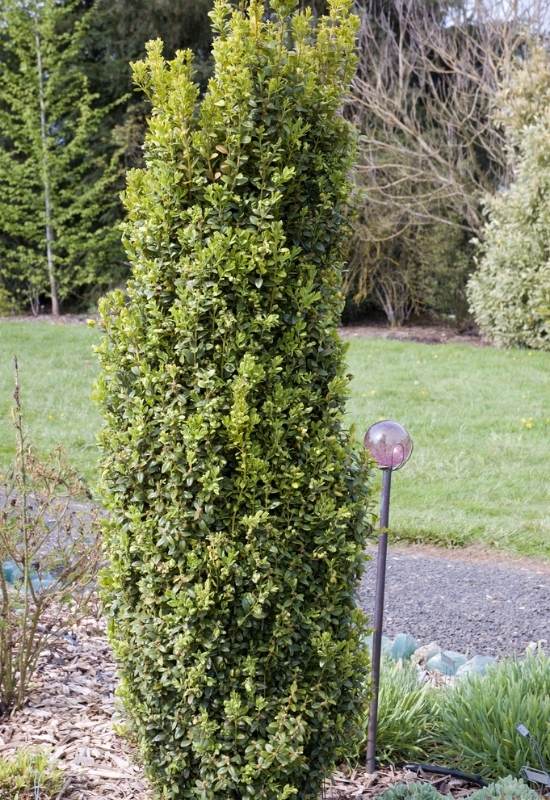
If you need an evergreen that grows tall but stays narrow to screen a small garden, ‘Graham Blandy’ is the boxwood variety for you.
It can tower up to 15 feet high but will never grow more than 2 feet wide. With its perfect, elegant conical shape and dense green foliage composed of countless small oval leaves, it forms an ideal shield when planted in rows. This easy-to-grow shrub also produces small, fragrant flowers in shades of cream, yellow, or green, though it is primarily loved for its dense and sturdy green canopy. It has also earned the Award of Garden Merit from the Royal Horticultural Society.
Like all boxwoods, ‘Graham Blandy’ is very receptive to pruning, so much so that it’s suitable for topiaries. This quality makes it a great choice for very formal gardens, which is a special trait among shrubs.
Hardiness: USDA zones 5 to 9.
Light exposure: Full Sun, partial shade, or full shade.
Blooming season: Spring, with inconspicuous flowers.
Size: 5 to 15 feet tall (1.5 to 4.5 meters) and 1 to 2 feet in spread (30 to 60 cm).
Soil requirements: Well drained loam, clay, chalk, or sand-based soil with a pH from mildly alkaline to mildly acidic. It is drought tolerant once established but prefers regular watering.
12. ‘Illuminati Tower’ Mock Orange (Philadelphus coronarius ‘Illuminati Tower’)
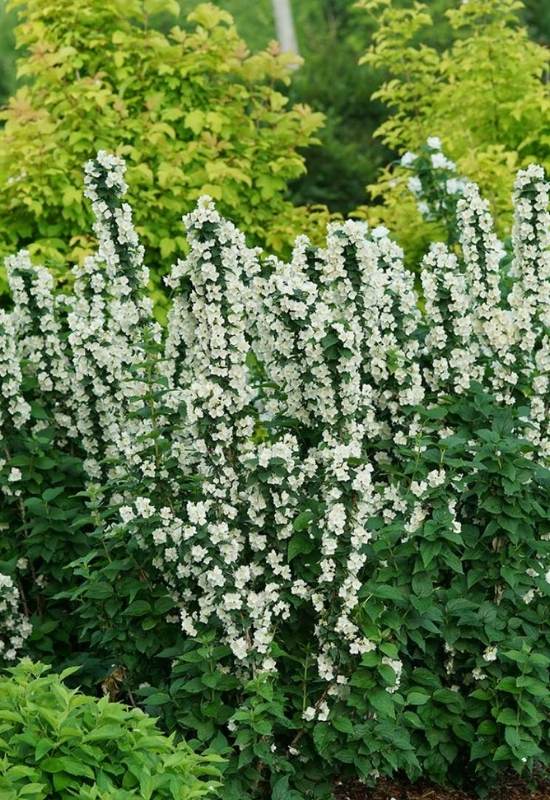
The ‘Illuminati Tower’ cultivar of mock orange is unique because of its tall and narrow growth, unlike others that tend to spread widely. When planted in a container, it will reach the perfect height to keep unwanted eyes off your property, thanks to its dense, mid to dark green foliage.
But this deciduous shrub has much more to offer your small garden. It will be literally covered in a sea of pure, round, snow-white flowers with a cream center and a strong, fresh fragrance. It will also attract many butterflies and pollinators to your green space, adding a fluttering display of color and life.
‘Illuminati Tower’ is perfect for small, informal garden styles like cottage and English country gardens, as well as urban and suburban settings, as long as you appreciate the fresh look and aroma of this traditional-looking shrub.
Hardiness: USDA zones 4 to 7.
Light exposure: Full Sun or partial shade.
Blooming season: Late spring and early summer.
Size: Up to 5 feet tall (1.5 meters) and 1 to 2 feet in spread (30 to 60 cm), but containers can make it even taller.
Soil requirements: Medium fertile, regularly moist and well drained loam, clay, chalk, or sand with a pH from mildly alkaline to mildly acidic. It tolerates heavy clay.
13. ‘Pinpoint’ Blue False Cypress (Chamaecyparis lawsoniana ‘Pinpoint’)
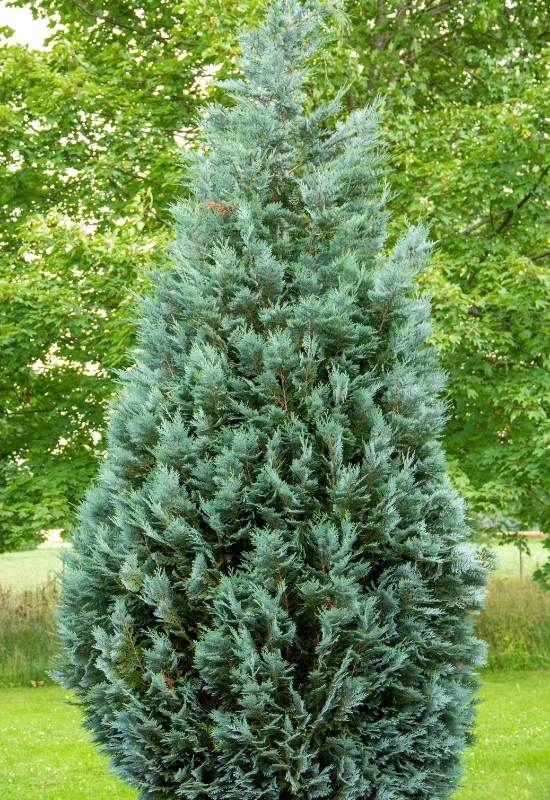
The ‘Pinpoint’ blue false cypress will shield your garden’s privacy with its dense foliage and tall, narrow, needle-like shape. With its slender conical habit and impenetrable bluish-green leaves, this shrub can reach 20 feet in height but will only occupy a maximum of 5 feet of ground space.
Like all conifers, it is evergreen, meaning it will protect you and your family even in the cold of winter when most other shrubs have bare branches. It is a low maintenance and very architectural plant, so you can easily grow it even if you don’t have much time for gardening.
‘Pinpoint’ looks fantastic in urban, suburban, and gravel gardens, among others. You can plant it in rows to create a tall hedge or windscreen, or use it as a valuable specimen plant, thanks to its distinctive shape.
Hardiness: USDA zones 5 to 7.
Light exposure: Full Sun or partial shade.
Blooming season: N/A.
Size: 15 to 20 feet tall (4.5 to 6.0 meters) and 4 to 5 feet in spread (1.2 to 1.5 meters).
Soil requirements: Medium fertile, regularly moist but well drained loam, clay, chalk, or sand with a pH from mildly acidic to neutral.
14. ‘Laced Up’ Elderberry (Sambucus nigra ‘Laced Up’)
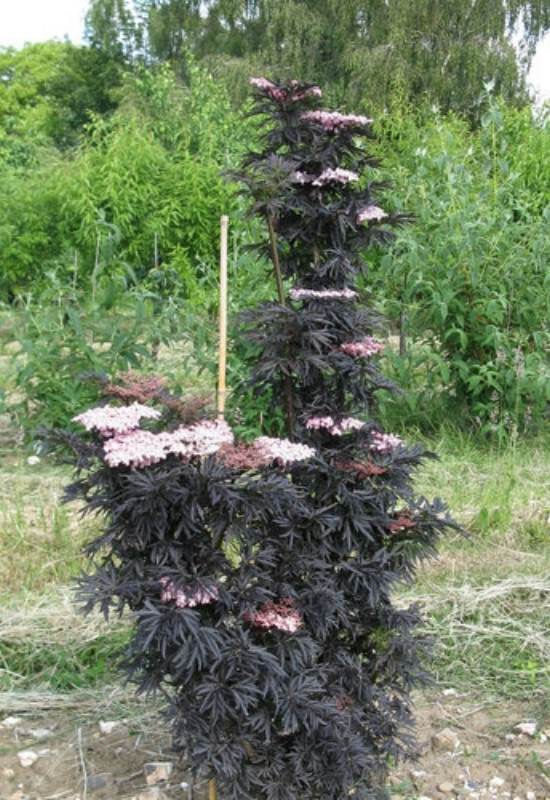
Prepare yourself for an astounding dark beauty that is tall, slim, and perfect for privacy: the ‘Laced Up’ elderberry. The deeply cut and lobed leaves of this shrub are so dark they are practically black.
In fact, it is one of the darkest foliage colors you will ever see. The leaves form a lace-like clump with amazing texture and chromatic value. The blooms provide a stunning contrast in color while maintaining the delicate texture theme. They are white and pink, gathered in wide, flat umbels at the ends of the branches. Unlike other varieties, this cultivar has a conical or columnar habit, making it an excellent fit for small gardens, but with a very Gothic twist.
‘Laced Up’ is a new cultivar with a striking beauty. You can even feature it in a modern-inspired garden, though it will suit any informal design, whether as a specimen plant or in groups for hedges and screens, or even in tall borders.
Hardiness: USDA zones 5 to 7.
Light exposure: Full Sun or partial shade.
Blooming season: Late spring and early summer.
Size: 6 to 10 feet tall (1.8 to 3.0 meters) and 4 to 6 feet in spread (1.2 to 1.8 meters).
Soil requirements: Moderately fertile, well drained but regularly moist loam, clay, chalk, or sand with a pH from mildly alkaline to mildly acidic. It tolerates heavy clay.
15. ‘Fastigiata Aurea’ Irish Yew (Taxus baccata ‘Fastigiata Aurea’)
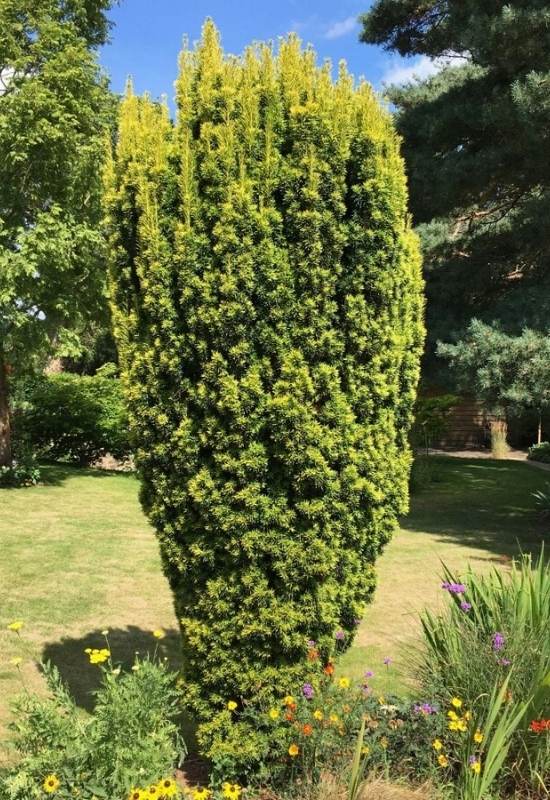
For a golden, towering shrub in medium to large gardens that can block views even from high-up windows, the ‘Fastigiata Aurea’ Irish yew is an ideal choice.
This columnar evergreen can grow to a whopping 30 feet tall but will never stretch more than 8 feet wide. All year round, it will fill your days with a thick, golden-green light, sometimes with a lime hue, creating what looks like a thinly decorated natural pillar. It will take time to reach its full size, but in the meantime, you will also enjoy its coral-red cones that resemble little cups or even Christmas decorations.
Yew is a favorite for screens and hedges due to its adaptability, but ‘Fastigiata Aurea’ stands out for its foliage color, unique vertical accent, and strength. Easy to grow and with few demands, it is a giant of both privacy and beauty.
Hardiness: USDA zones 7 to 8.
Light exposure: Full Sun, partial shade, or full shade.
Blooming season: N/A.
Size: 10 to 30 feet tall (3.0 to 9.0 meters) and 2 to 8 feet in spread (60 cm to 2.4 meters).
Soil requirements: Medium fertile and regularly moist but well drained loam, clay, chalk, or sand with a pH from mildly alkaline to mildly acidic.
Tall, Skinny and Beautiful Shrubs to Block Prying Eyes
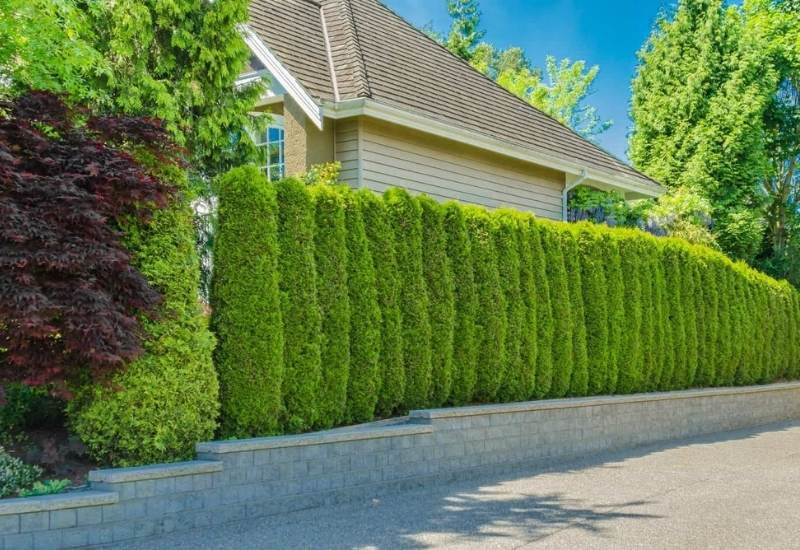
Some of the shrubs you’ve seen are better suited for very small gardens, while others require a bit more space. Some will bloom beautifully, and others will keep their leaves on all year round. Simply pick the best option for your situation and forget about people peeking into your property and private life.